- Dog law
- Portugal
- Walks
Dog Leash and Muzzle Laws in Portugal: 2026 Guide
On this page
TL;DR: Dog leash and muzzle laws in Portugal are often described incorrectly. The general national rule for an accompanied dog in a public place is a functional muzzle or a lead. Dogs legally classed as dangerous or potentially dangerous need both a functional muzzle and a short lead up to one metre. Municipalities can impose stricter local rules, so signs and local regulations still matter.
Visitors and new residents often hear a simple instruction: every dog must be on a lead everywhere. Portugal's national legislation is more specific. It separates the general rule for dogs in public from the stronger containment required for dangerous and potentially dangerous animals.
Understanding that distinction avoids two mistakes. One is giving an ordinary owner a rule the national text does not actually state. The other, more serious mistake is treating a listed or individually classified dog as if a normal long lead were enough.
This guide explains the national baseline in force in 2026. It is general information, not legal advice. Always check current municipal rules, signs and any order applying to your individual dog.
Does an ordinary dog need a lead or a muzzle in public?
Article 7 of Decree-Law 314/2003 sets the general public-space rule. Dogs must wear a collar or harness showing the keeper's name and contact details and must be accompanied by the keeper. The animal may circulate under control with a functional muzzle that prevents biting or eating, or with a lead.
The word “or” is important. At national level, the ordinary dog rule is not automatically “lead and muzzle.” In normal practice, most owners choose a lead because it is the clearest way to control direction and distance. A muzzle without a lead does not create reliable recall, prevent a dog running into traffic or stop unwanted approaches.
The law also gives local authorities room to regulate circulation. A Câmara Municipal can require stronger measures in designated places, establish dog areas and enforce park or beach conditions. The national baseline is therefore the beginning of the check, not always the end.
For responsible introductions, legal compliance is only the minimum. Our guide to introducing two dogs safely shows why neutral ground, distance and parallel movement matter even when both dogs are legally controlled.
When are both a short lead and muzzle required?
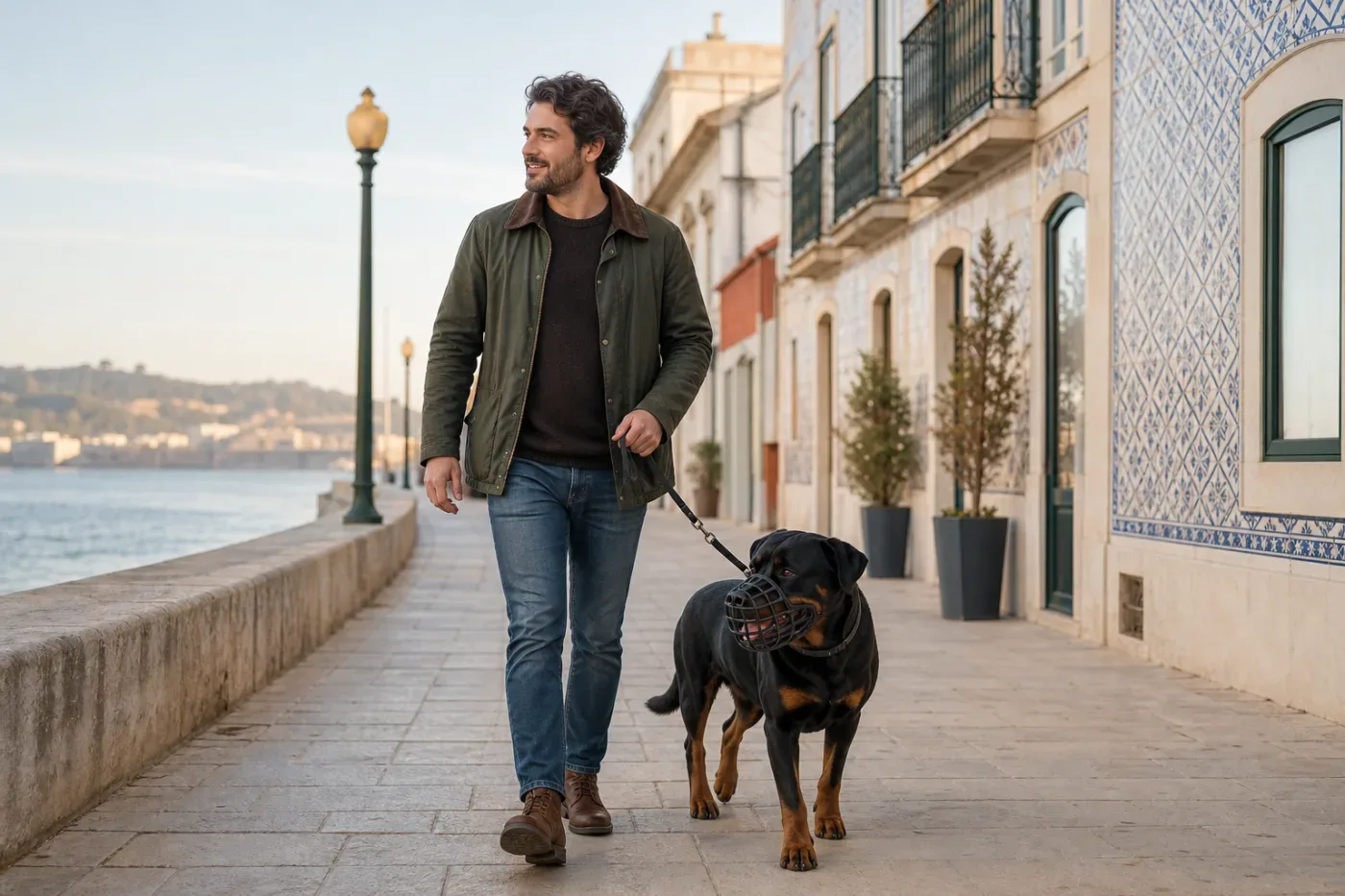
Portugal applies a separate regime to dangerous and potentially dangerous animals. Under Decree-Law 315/2009, a covered dog circulating on a public road, in a public place or in the shared part of a building must wear a functional muzzle and be secured by a short lead up to one metre, attached to a collar or harness.
These are simultaneous requirements. Choosing one does not replace the other. The handler also needs to meet the regime's conditions, and licensing, insurance, training and sterilisation duties may apply depending on the classification.
Our dedicated guide to potentially dangerous dogs in Portugal explains those wider responsibilities. This article stays focused on containment during ordinary movement outside the home.
| Dog's status | National public-space containment | Important note |
|---|---|---|
| Ordinary dog | Functional muzzle or lead | Municipal rules may be stricter |
| Potentially dangerous dog | Functional muzzle and short lead up to 1 m | Breed or crossbreed can trigger the regime |
| Individually dangerous dog | Functional muzzle and short lead up to 1 m | Classification can apply to any breed |
Which dogs are considered potentially dangerous?
Ordinance 422/2004 names seven breed groups and their crosses: Fila Brasileiro, Dogo Argentino, Pit Bull Terrier, Rottweiler, American Staffordshire Terrier, Staffordshire Bull Terrier and Tosa Inu.
This list is frequently expanded by rumour. Cane Corso, Doberman and Alaskan Malamute are not on Portugal's national seven-breed list. That does not mean every individual of those breeds is exempt from control. Breed is only one route into the legal regime.
An individual dog of any breed or mixture can be classed as dangerous after behaviour such as an attack or attempted attack, or when the competent authority considers it a risk following recorded conduct. Owners should never treat “not on the list” as permission to ignore a formal decision about their dog.
The regime has been amended, including through Law 46/2013 and Decree-Law 9/2021. Older articles may quote a superseded procedure even when the core containment rule remains recognisable. Use the consolidated official legislation rather than a pet-business summary.
What counts as a functional muzzle?
For the dangerous-dog regime, the legal text describes a muzzle that prevents the dog from eating or biting. That function must be balanced with animal welfare and the situation in which it is worn.
For walking and training, a correctly sized basket muzzle is normally the safest design because the dog can open the mouth to pant. The basket should allow drinking and reward delivery while preventing a bite according to the risk level and construction. A loose decorative strap that the dog can remove is not functional. A tight fabric sleeve that holds the mouth closed is not suitable for exercise or a long outdoor period.
Fit must be tested on the individual dog. Large heads vary considerably even within a breed. Check pant depth, nose clearance, eye clearance and strap security. Our step-by-step guide on how to muzzle train a dog explains how to introduce the equipment without pushing it onto the face.
A muzzle does not make an unsafe interaction safe. A dog can still charge, knock over another dog or become more distressed when strangers approach. Keep the lead, distance and exit route that the situation requires.
Where can a dog legally go off lead?
There is no safe shortcut such as “all parks allow it” or “empty beaches are fine.” Access depends on national status, municipal regulation, posted conditions and sometimes the season.
Municipalities can create enclosed dog parks where ordinary dogs may be released under stated rules. An official dog-park regulation may require supervision, immediate removal after conflict, vaccination or a lead while entering and leaving. It may exclude dogs covered by the dangerous-dog regime or require their legal equipment to remain in use.
Beaches are also governed by local and concession rules. A beach that permits dogs during winter may prohibit them during the bathing season. Nature reserves can have separate wildlife protections. Read the sign at the actual entrance rather than relying on an old social post.
Even where release is allowed, the keeper remains responsible for control and damage. A dog who ignores recall around dogs, cyclists or wildlife is not ready for an unenclosed public space. A long line can provide more freedom while preserving a physical connection, provided it is handled away from crowded paths and does not wrap around people or dogs.
Can municipalities make stricter dog-walking rules?
Yes. Decree-Law 314/2003 expressly allows municipal authorities to regulate dog circulation and create dog zones. This is why rules can differ between Lisbon, Porto and a smaller freguesia, and between two parks in the same municipality.
An owner should check:
- the Câmara Municipal's animal or public-space regulation
- signs at parks, gardens, promenades and beaches
- the specific rules of a fenced dog area
- seasonal beach notices
- public-transport operator conditions
- any individual order attached to the dog
Transport is a separate setting. Operators can require an appropriate carrier or muzzle and lead, restrict travel times or refuse access under defined conditions. Check the operator's current rules before the journey. Do not assume the street rule automatically answers the bus, train or ferry question.
What can happen if an owner ignores the rules?
The legislation creates administrative offences and penalties, but the exact consequence depends on the breached provision, the dog's status and the authority handling the case. A serious incident can produce more than a simple fine. It may lead to individual dangerous classification, mandatory measures, civil liability or criminal consequences where injury or reckless handling is involved.
Avoid relying on a single “the fine is exactly X” figure copied from an undated article. Amendments, classification and local provisions affect the range. The official consolidated text and the competent authority are the right sources for a live case.
Insurance is particularly important for dogs under the dangerous or potentially dangerous regime. It protects neither the dog nor owner from enforcement, but failing to hold required cover creates another legal problem. Keep the licence and other documents current rather than waiting for a street check.
How should owners prepare for a lawful, calm walk?
Use a short pre-walk check:
- confirm the collar or harness is secure and carries the required identification
- inspect clips, lead stitching and muzzle straps
- take the correct legal equipment for the dog's classification
- choose a route with enough space to move away
- read temporary and permanent signs
- carry waste bags and water
- avoid greetings when either dog is tense or overexcited
For large dogs, equipment failure has greater consequences because the handler may not recover with strength alone. Use a lead that can be held comfortably with both hands, but never wrap it around the wrist. Train an exit cue before practising near distractions.
When meeting another dog, ask before approaching. Begin side by side at distance instead of tightening both leads for a nose-to-nose greeting. The safe group-walk guide explains how to plan spacing, handler numbers and breaks.
The legal rule answers what containment must be present. It does not tell you whether a particular dog wants contact or whether the location is suitable for play. Combine the law with honest behaviour information, enough space and a plan to leave. To find owners interested in structured, compatible walks, get Fennaro.
Common questions
Must every dog wear a leash in public in Portugal?
National law generally requires an accompanied dog in public to use either a functional muzzle or a lead. Dangerous and potentially dangerous dogs face the stricter combination of a functional muzzle and a short lead. Municipal rules and signs can impose tighter controls in particular places.
Must every dog wear a muzzle in Portugal?
No. An ordinary dog does not automatically need both a muzzle and a lead under the general national rule. A functional muzzle is one permitted control option. Dogs legally classified as dangerous or potentially dangerous must use a functional muzzle together with a short lead in public places.
Can dogs be off lead in Portugal?
Off-lead access depends on the dog's legal classification and the specific place. Municipalities may designate dog parks or other areas and set their own conditions. Never assume an open green space permits it. Check entrance signs, local regulations and whether the dog has reliable recall.
Is a Cane Corso a potentially dangerous breed in Portugal?
Cane Corso is not one of the seven breeds named in Portugal's national potentially dangerous list. However, an individual dog of any breed can be classified as dangerous because of an attack, attempted attack or formally recorded aggressive behaviour. Local rules and case-specific orders can still apply.
How short must the lead be for a dangerous dog?
A dog covered by Portugal's dangerous or potentially dangerous regime must be secured with a short lead up to one metre, attached to a collar or harness, while also wearing a functional muzzle in public. The handler must meet the legal conditions for controlling that dog.
Where can I check the dog rules for a Portuguese municipality?
Start with the Câmara Municipal website and the rules displayed at the entrance to beaches, parks and dog areas. Search for the municipality's animal, public-space or municipal-police regulation. If wording is unclear, ask the municipality directly before allowing a dog off lead or entering a restricted area.