- Training
- Dog safety
- Muzzles
How to Muzzle Train a Dog: Step-by-Step Guide
On this page
TL;DR: To learn how to muzzle train a dog, start with a well-fitted basket muzzle and reward the dog for choosing to put their nose inside. Add the strap, movement and real-world use in small stages. Never use the muzzle to force a dog into contact, and step back whenever the dog freezes, avoids it or cannot take food comfortably.
A basket muzzle can give a dog more freedom, not less. It can make a veterinary visit safer, stop scavenging on a walk or add protection while a behaviour plan is underway. The difference between a useful safety tool and a frightening restraint is preparation.
Good training does not begin by fastening the muzzle. It begins with fit, choice and a dog who is calm enough to learn. The process can take a few days for one dog and several weeks for another. Speed is not the target. Comfortable, repeatable behaviour is.
The Cornell University College of Veterinary Medicine basket-muzzle guide recommends short sessions and teaching two separate skills: willingly placing the nose inside, then accepting the strap. That separation keeps each lesson clear.
Why should a friendly dog learn to wear a muzzle?
Any dog can become frightened or defensive when injured. A normally relaxed Rottweiler may react when a painful paw is examined. A friendly Cane Corso may panic after an accident. Training in advance means the first muzzle experience does not happen during the worst moment of the dog's week.
A muzzle can be useful for:
- veterinary examinations and emergency handling
- grooming when pain or fear creates bite risk
- preventing a dog from eating unsafe items
- legal requirements in a particular place
- carefully managed behaviour work with professional guidance
- safer transport after an injury
It is not a punishment and should never be used to silence barking, stop normal body language or make unwanted social contact acceptable. A muzzled dog still needs space. The equipment manages one consequence, but it does not change the feeling that caused growling, lunging or avoidance.
If your dog struggles around other dogs, begin with our guide on socialising a reactive dog. The training goal is comfort at a safe distance, not forcing a greeting because biting is harder.
Which type of muzzle is safe for training and walks?
A basket muzzle is usually the right choice for training and active use. Its rigid or semi-rigid structure should leave room for a full pant, drinking and small treats. The PDSA veterinary guide explains why a dog must be able to open the mouth and warns that a mouth-closing muzzle can create distress and heat risk if used beyond a very short procedure.
| Muzzle type | Suitable use | Main limitation |
|---|---|---|
| Basket muzzle | Walks, training, vet visits and managed situations | Must be measured carefully for pant room |
| Fabric or sleeve muzzle | Very brief supervised clinical procedure | Prevents normal panting, drinking and treat delivery |
| Custom basket | Dogs whose face shape does not fit standard models | More expensive and may take time to obtain |
| Scavenging guard | Added to a suitable basket to block food pickup | Can reduce treat access and airflow if poorly designed |
A basket is not automatically bite-proof. Material, gaps and construction differ. If there is a known bite history, ask a qualified professional to assess the model and the full safety plan. Do not assume that a soft rubber basket provides the same protection as a purpose-built bite-resistant design.
Flat-faced dogs need particular care because breathing is already restricted by anatomy. The wrong muzzle can worsen airflow. Ask a veterinarian about a model designed for the dog's face and stop immediately if breathing changes.
How do you measure a dog for a basket muzzle?
Measure the dog, not the breed label. Two dogs of the same breed can have different head widths and nose lengths. Follow the chosen manufacturer's measuring points because they are not identical across brands.
The finished fit needs:
- enough depth for the dog's mouth to open into a genuine full pant
- clearance between the nose and the front of the basket
- straps that hold the basket stable without pressing into skin
- space below the eyes so the rim does not rub or block vision
- security when the dog shakes, backs away or moves a paw over the basket
The VCA Animal Hospitals muzzle-training guidance notes that a proper basket allows panting, treats and visible body-language signals. Test those functions before relying on it outdoors. Watch the dog from the side while panting rather than checking only with the mouth closed.
Large dogs create an extra practical problem: a heavy basket can tip or rub as they move. Check where the weight sits and whether a head strap is needed. Hair loss, pink skin or repeated face rubbing after a walk means the fit or model needs attention.
How do you introduce the muzzle in the first sessions?
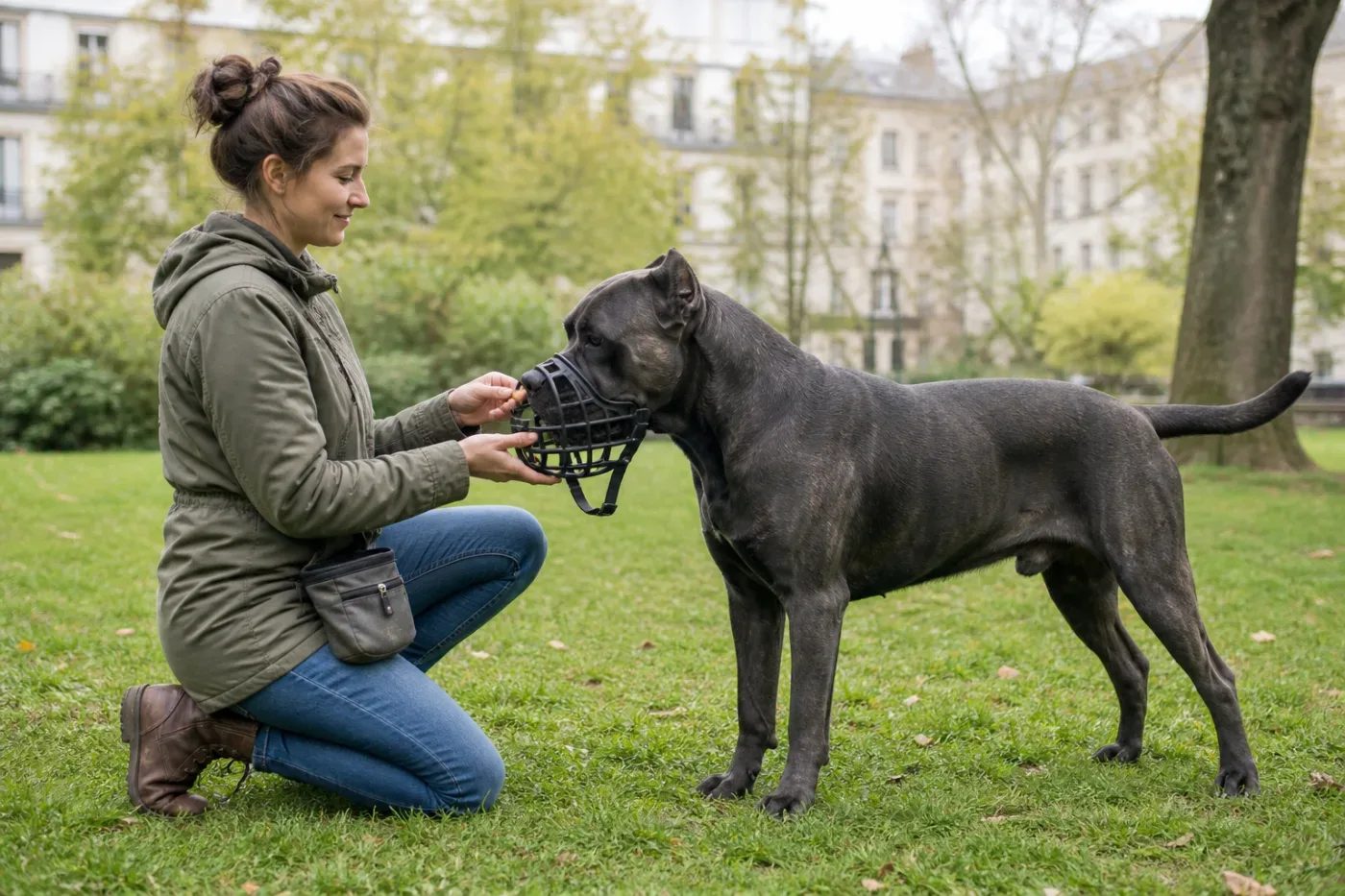
Choose a quiet room and high-value food the dog can safely eat. Put the muzzle behind your back before the session, then present it at a comfortable distance. Let the dog look and approach. Mark or calmly praise that choice and place food away from the muzzle so the dog resets.
Next, hold the basket still with the opening toward the dog. Put a treat inside where it can be reached without fastening anything. The dog should move their nose toward the basket. Do not push the basket onto the face.
After several easy repetitions, offer the empty basket. When the dog places the nose inside, feed through the front. Build from a brief touch to one second, then two or three seconds. End while the dog still wants another turn.
The Oregon Humane Society training plan also recommends a basket that permits treats and panting. Sessions can be one or two minutes. Several calm successes are better than one long attempt that ends in pawing.
Keep the muzzle out of reach between sessions. It should predict a structured game, not become a chew toy.
When should you add the straps?
Touching and fastening the straps are separate steps. First, while the dog's nose is voluntarily inside, move one strap slightly. Reward and release. Then touch the strap to the neck for a moment. Only after that is easy should you bring the ends together.
Fasten for one second, feed through the basket, unfasten and finish. Increase duration in small, uneven steps: one second, three seconds, two seconds, five seconds. Shorter repetitions prevent the dog from learning that every success leads to a harder demand.
The Veterinary Partner muzzle-conditioning guide suggests using safe lickable food through the basket to build duration. Choose food that suits your dog and avoid ingredients such as xylitol, which is toxic to dogs.
Do not solve pawing by holding the dog's legs, tightening every strap or immediately walking fast. Pawing can mean the training moved too quickly or the equipment is uncomfortable. Remove the muzzle calmly, check the skin and return to voluntary nose entry later.
How do you progress from the living room to a real walk?
Duration comes before difficulty. Once the dog can wear the muzzle calmly indoors, practise a few familiar behaviours: hand target, sit, walking across the room and drinking from a bowl. Keep reinforcement frequent.
Then change one variable at a time:
| Stage | Setting | Success sign |
|---|---|---|
| 1 | Quiet room | Dog places nose in and waits for the strap |
| 2 | Moving around home | Dog walks, drinks and responds normally |
| 3 | Hallway or garden | Dog can sniff and return attention |
| 4 | Short quiet walk | Dog pants freely and ignores the basket |
| 5 | Planned real use | Dog stays below their stress threshold |
The American Veterinary Society of Animal Behavior highlights the value of basket styles that allow drinking. Carry water on warm walks and inspect fit again after the dog has been moving. Never leave a muzzled dog unattended, in a crate or exposed to heat.
If the intended use involves another dog, begin at a generous distance. Parallel walking is safer than a face-to-face greeting. Our guide to introducing two dogs safely explains how to use neutral ground, loose movement and planned exits.
What signs mean the training is moving too fast?
Learning stops when the dog is overwhelmed. Look beyond whether the dog remains still. Freezing is not the same as comfort.
Pause or step back if you see:
- turning the head away whenever the muzzle appears
- leaving the room or hiding
- a closed, tense mouth before the muzzle is even fitted
- frantic pawing, rolling or rubbing
- refusal of food the dog normally values
- very rapid breathing unrelated to exercise or heat
- repeated attempts to bite the basket
Check for a physical cause first. The edge may touch the nose, press below an eye or block a full pant. If fit looks sound, return to the last stage where the dog approached willingly. A dog who has previously been forced into a muzzle may need a new model and a much slower association process.
For intense fear, handling sensitivity or a bite history, involve a veterinarian and an accredited reward-based behaviour professional. Pain and medical problems must be ruled out. Online instructions cannot assess the dog, equipment and environment in front of you.
What can a muzzle never replace?
A muzzle does not replace distance, a secure lead, supervision, training or honest communication. It also does not give strangers permission to touch the dog. Tell people clearly that your dog needs space.
During play, a basket changes how a dog can communicate and interact. It can catch on equipment or strike another dog. Controlled walking may be appropriate while wrestling is not. Read our guide to whether dogs are playing or fighting before arranging any off-lead interaction.
If a dog repeatedly goes over threshold, stop creating that situation. Find quieter routes, increase distance and work on behaviour below the reaction point. The muzzle is a backup layer, not a reason to test how much the dog will tolerate.
Muzzle training succeeds when the dog sees the basket and chooses to participate. Keep that choice throughout the process. Build the fit, nose target, strap, duration and real-world context separately, and the equipment becomes ordinary long before it is essential. For safer, planned walks with owners who can discuss their dogs honestly, get Fennaro.
Common questions
How long does it take to muzzle train a dog?
Some dogs become comfortable in several short sessions, while fearful dogs may need weeks. Progress depends on the dog's history and the fit of the muzzle, not a fixed calendar. Move forward only when the dog approaches willingly and shows relaxed body language at the current step.
Can a dog wear a muzzle for a long walk?
A correctly fitted basket muzzle can be suitable for a walk because it allows a full pant, drinking and treats. Check the manufacturer's guidance and the dog often. A tight fabric or grooming muzzle that holds the mouth closed is not suitable for exercise or extended wear.
How do I know whether a basket muzzle fits?
The dog needs enough depth to open the mouth into a full pant, space in front of the nose, stable straps and no rubbing near the eyes. The dog should not be able to remove it. Breed-based size charts are only a starting point, so measure the individual dog.
What should I do if my dog freezes or paws at the muzzle?
Remove the pressure and return to an easier step. Freezing, frantic pawing, hiding or refusing normally valuable food means the session is too difficult. Do not tighten the muzzle or distract the dog until they surrender. Rebuild a voluntary nose target and shorten the next session.
Does a muzzle make it safe to let dogs meet?
No. A muzzle reduces bite risk but does not make an uncomfortable dog enjoy contact. A dog can still charge, pin or injure another dog with its body. Keep distance, use a lead, read both dogs and arrange controlled introductions instead of relying on equipment alone.
Should every dog learn to wear a muzzle?
Muzzle training is useful even for friendly dogs. Pain, injury, emergency transport or unfamiliar handling can change behaviour. Teaching the skill before it is urgently needed gives the dog choice and time, making future veterinary care or safety management less stressful for everyone involved.