- Body language
- Dog play
- Big breeds
Are Your Dogs Playing or Fighting? A Big-Dog Guide
On this page
TL;DR: Are my dogs playing or fighting? Check the body, not the noise. Play looks loose and bouncy, with play bows, turn-taking, and role reversal, where the stronger dog voluntarily ends up on the bottom. Fighting looks stiff and efficient: hard stare, closed mouth, pinning without release. When in doubt, run a consent test: separate the dogs for a few seconds and see if both dive back in. With 40-kilo dogs, learn the escalation ladder and the safe break-up methods before you need them, because misreading big-dog play costs more.
How can you tell if dogs are playing or fighting?
Every big-dog owner knows the moment: two large dogs collide at full speed, teeth flash, someone's dog screams like a banshee, and every human head at the park snaps around. Nine times out of ten it is play. The tenth time is why you should be able to tell, fast.
The reliable signals live in the body, not the sound:
| Play | Fight |
|---|---|
| Loose, bouncy, exaggerated movement | Stiff, efficient, fast movement |
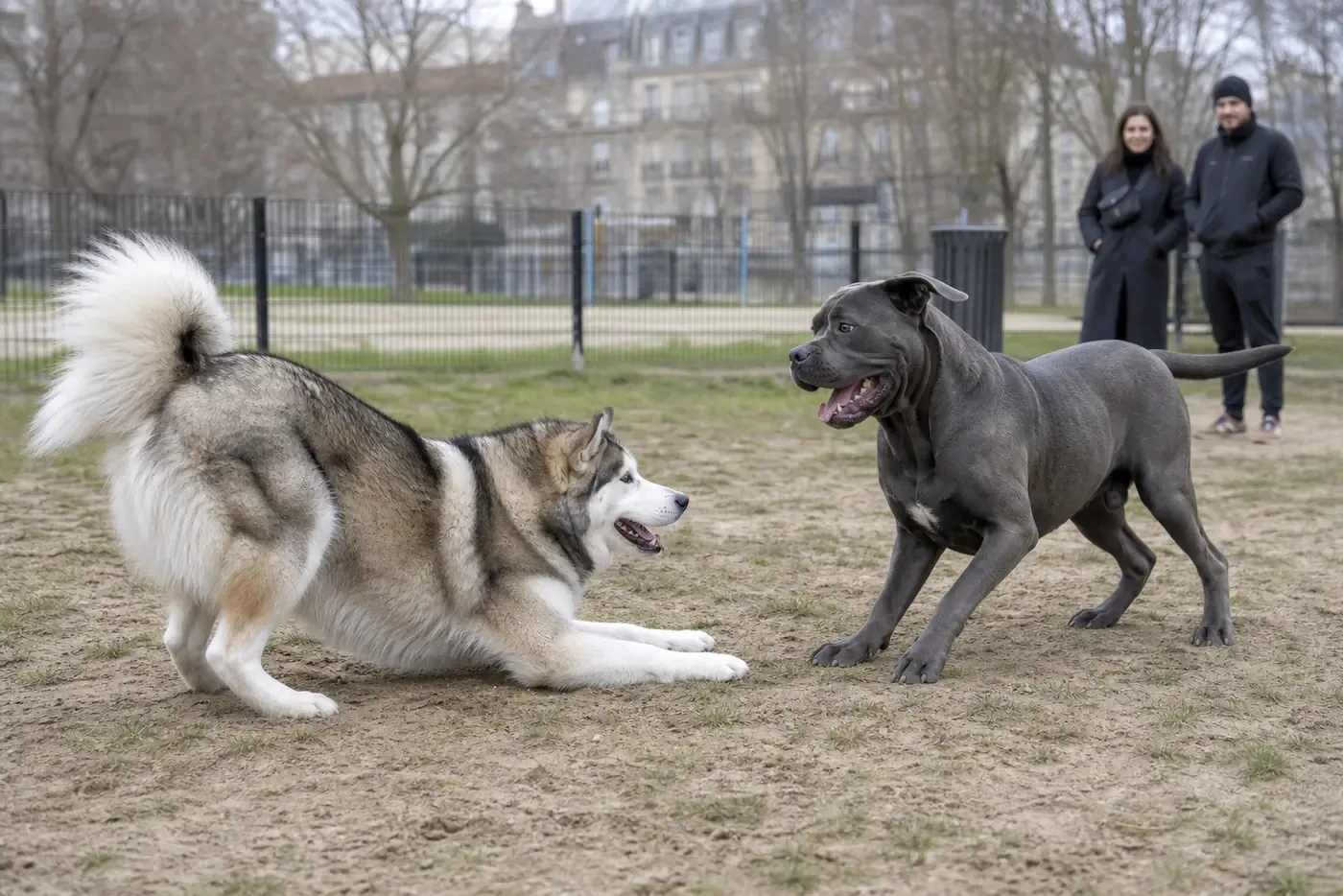
| Play bow (chest down, rear up) | Frozen posture, weight forward |
| Open, relaxed mouth | Closed mouth, curled lip |
| Turn-taking, both dogs "win" sometimes | One dog always on top, pinning without release |
| Big, silly, bouncing leaps | Quick, targeted lunges |
| Dogs pause, shake off, re-engage | No pauses, escalating intensity |
| Either dog can leave and returns freely | One dog trying to escape, the other pursuing |
The American Kennel Club's baseline list matches this picture and adds a rule big-dog owners should take personally: do not let large dogs wrestle much smaller ones, and remove food and toys from group play entirely (AKC, 2024). A 2026 daycare-operator guide compresses the whole thing into one sentence worth memorizing: in healthy play, both dogs choose to participate, and either dog can pause or walk away without being chased or pressured (Camp Bow Wow, 2026).
What does a dog's play bow actually mean?
The play bow, chest to the ground and rear in the air, is the oldest verified phrase in dog language. Marc Bekoff, the researcher who documented it in a 1977 study in Science, describes it as a ritualized signal meaning "let's play" or, crucially, "whatever comes next is still play" (Psychology Today, 2025).
That second meaning is the one that saves big-dog owners from panic. A bow followed by bared teeth, growling, and a full-speed tackle is not a betrayal of the bow; it is exactly what the bow announced. Bekoff's research found play partners react with submission or avoidance only about 15 percent of the time when a bow precedes rough moves, meaning dogs trust the signal roughly 85 percent of the time. Dogs read the grammar. Humans hear the growl and forget the bow that came before it.
What are self-handicapping and role reversal, and why do they matter?
These two mechanisms are how dogs keep play fair, and for big breeds they are the entire ballgame.
Self-handicapping means a dog voluntarily plays below its power: soft mouth, pulled punches, half-speed tackles. Role reversal means the stronger or higher-status dog deliberately takes the losing position, flopping onto its back under a dog it could flatten. Dogs that refuse to do either get excluded from play by other dogs over time; fairness is enforced by the group (Psychology Today, 2025).
Watch for it when your Cane Corso plays with anything smaller than itself. A 45-kilo dog rolling belly-up beneath a 20-kilo dog is not weakness; it is the clearest green flag in the language. And a big dog that never self-handicaps with smaller or newer playmates is telling you something important about which playmates it should have. That is precisely the kind of matching worth doing before the meeting, not during it, and it is what Fennaro's size- and temperament-matching exists for.
How do you run a consent test while two dogs are playing?
The consent test settles almost every "is this okay?" moment in seconds, and certified behavior consultants treat it as the standard tool (IAABC Foundation Journal, 2023). Interrupt the play: call the dogs, or gently lead the more intense one a few steps away. Then release and watch.
Both dogs dive back in with loose bodies: it was play, carry on. The dog that was underneath hesitates, sniffs the ground, or drifts toward you: it was done, and the pause just saved it from having to say so the hard way. There is also a subtler pattern the IAABC piece names: the dog that keeps playing while anxious because its stop signals have been ignored before. With a new playmate, err on the side of more pauses. Behavior consultant Allie Bender interrupts unfamiliar pairs more often than seems necessary, before any warning sign, and gives established pairs more slack (Whole Dog Journal, 2024). Certified trainer Cathy Madson puts a number on it: pause every 5 to 10 minutes regardless of how good it looks (Preventive Vet, 2023).
What is the escalation ladder before play turns into a fight?
Dogs almost never "snap out of nowhere." They climb a ladder of increasingly loud signals, described in Kendal Shepherd's 2004 ladder of aggression model, and fights happen when every lower rung got ignored (HPDT, 2026). The climb looks like this: yawning, head turning, and lip licking at the bottom; slowing down, crouching, walking away in the middle; freezing, hard staring, and growling near the top; then snapping and biting.
During play, the rungs that matter are the middle ones. A dog that stops bouncing and starts stiffening, a mouth that closes, a stare that hardens, a pin that does not release when the pinned dog squirms: that is the game ending in real time. Interrupt at the freeze, not at the growl. And never punish the growl itself; owners who do teach their dog to skip the warning and go straight to the bite.
When should you actually break up dog play?
Break it up early and cheerfully, not late and desperately. Interrupt when you see stacked stress signals (stiffening plus hard stare plus one dog trying to leave), when the same dog ends up on the bottom over and over, when yelps go unanswered by a pause, or when intensity keeps ratcheting up without the little breaks healthy play takes naturally.
The good news about early interruptions: they cost nothing. Done with a happy voice and a treat, they read as part of the game. Madson's observation from years of dog parks applies here: almost every scuffle she has seen could have been prevented by owners simply paying attention (Preventive Vet, 2023). If the meeting itself was set up right, with matched dogs on neutral ground, you will rarely get past this paragraph. Our introduction protocol for big dogs covers that setup, and the safe meetup guide handles the group version.
How do you safely break up a fight between two 40kg dogs?
First, the never list, because instinct gets people bitten: never put your hands between fighting dogs, never grab collars near the head, never pry jaws, never step between them with your legs (Preventive Vet, 2024). Fighting dogs do not recognize their owners mid-fight, and redirected bites are how loving owners end up in emergency rooms.
The escalation order that works: start hands-off with a loud noise, a burst of water, or a physical barrier like a board or a chair shoved between them. If hands-on becomes unavoidable and there are two of you, use the wheelbarrow method: each person grabs one dog's hind legs above the knee (below the knee risks wrecking the joint), lifts the rear off the ground, and walks backward. A dog standing only on its front legs cannot lunge.
Be honest about physics with a giant breed: a lone owner should not attempt a hands-on break-up of two 40-kilo-plus dogs. Noise, water, barrier, and voice are your tools until help arrives. The best fight strategy at this size is the one you executed weeks earlier, by choosing the right playmate in the first place.
Do big breeds play differently from each other?
Yes, and knowing your own dog's style prevents half the false alarms. Vet-reviewed play-style guides name full-contact play, body slamming and bowling over a playmate, as a normal style, not a warning sign (Dogster, 2026). Malamutes, built for impact, love it. Pitbull-type dogs lean toward wrestling and loud bitey-face with constant role swapping, which looks alarmingly like a real grip fight to an outsider and is nothing of the sort between matched partners. Dobermans often prefer chase-and-evade, which means their play reads as pursuit and needs its consent tests run at the pauses, since you cannot call a dog apart mid-sprint.
The risk is never the style. It is the mismatch: a body-slammer on a soft-touch player, a wrestler on a fragile senior, a 45-kilo chase enthusiast on a 6-kilo target. Match size and play style and the loudest, most violent-looking play at the park is just two well-suited dogs having the time of their lives. That matching is exactly what Fennaro does before the first meeting, and if you are still deciding whether your dog needs regular playmates at all, start with does my dog need a friend. For the teenage months when play skills wobble hardest, our big-breed adolescence guide is the companion read.
Read the body, trust the bow, test the consent, and pick playmates like it matters. It does: every well-run play session your big dog has is one more bystander who watched two huge dogs play beautifully and adjusted their opinion of big dogs accordingly.
Common questions
Is it normal for big dogs to growl loudly when they play?
Usually, yes. Play growls are typically higher-pitched and shorter than a real warning growl, and they come wrapped in loose, bouncy body language. Guardian breeds like Rottweilers and Dobermans are vocal communicators in general, so their play simply sounds bigger. Judge the body, not the volume: looseness means play, stiffness means trouble, whatever the soundtrack.
How do I know if my dog is playing too rough?
Pause the play every five to ten minutes rather than waiting for a warning sign. Watch for one dog repeatedly trying to escape, or mouthing aimed hard at the head and neck with yelps. Then run a consent test: separate the dogs for a few seconds and release. If the dog that was underneath bounces straight back in with a loose body, it was still play.
What is the wheelbarrow method for breaking up a dog fight?
Two people each grab one dog's hind legs above the knee, never below it, lift the hindquarters off the ground and walk backward. A dog balanced on its front legs cannot lunge, which makes this far safer than grabbing collars. It needs two people. Alone, start hands-off instead: loud noise, water, or a physical barrier between the dogs.
Why does my big dog roll onto his back when playing with a smaller dog?
That is role reversal, one of the fairness mechanisms in dog play. A stronger dog voluntarily takes the losing position to keep the game fun for a weaker partner, and dogs that refuse to do this tend to get excluded from play by other dogs over time. A big dog going belly-up for a small one is a green flag, not weakness.
How often should I interrupt dog play to check in?
With unfamiliar dogs or puppies, interrupt more often than feels necessary, before any warning sign appears. With an established pair that plays well together, you can space check-ins out. The consent test takes seconds: call the dogs apart, then watch whether both choose to dive back in. Two yeses mean play continues. One hesitation means a longer break.
Is body slamming during dog play dangerous?
Not by itself. Full-contact play is one of the recognized normal dog play styles, and breeds built like Malamutes favor it. The real injury risk is a mismatch: a body-slammer paired with a much smaller or softer playmate. Match dogs by size and play style and the collisions that terrify bystanders are just two well-suited dogs enjoying themselves loudly.