- Adolescence
- Training
- Big breeds
Adolescent Dog Behavior: Why Big Breeds Take Longer
On this page
TL;DR: Adolescent dog behavior peaks between roughly 8 and 24 months: known cues stop working, recall evaporates, and reactivity appears out of nowhere. Science says this is a temporary, attachment-linked phase, not failed training. One study found adolescent dogs twice as likely to ignore their own carer's cue while obeying strangers just fine. The catch for big-dog owners: large and giant breeds stay in this phase longer, often well past two years, with adult size and strength arriving long before adult judgment. The way through is patience, short sessions, and structured contact with well-matched dogs.
What Is Canine Adolescence, and Why Does It Feel Like a Personality Change?
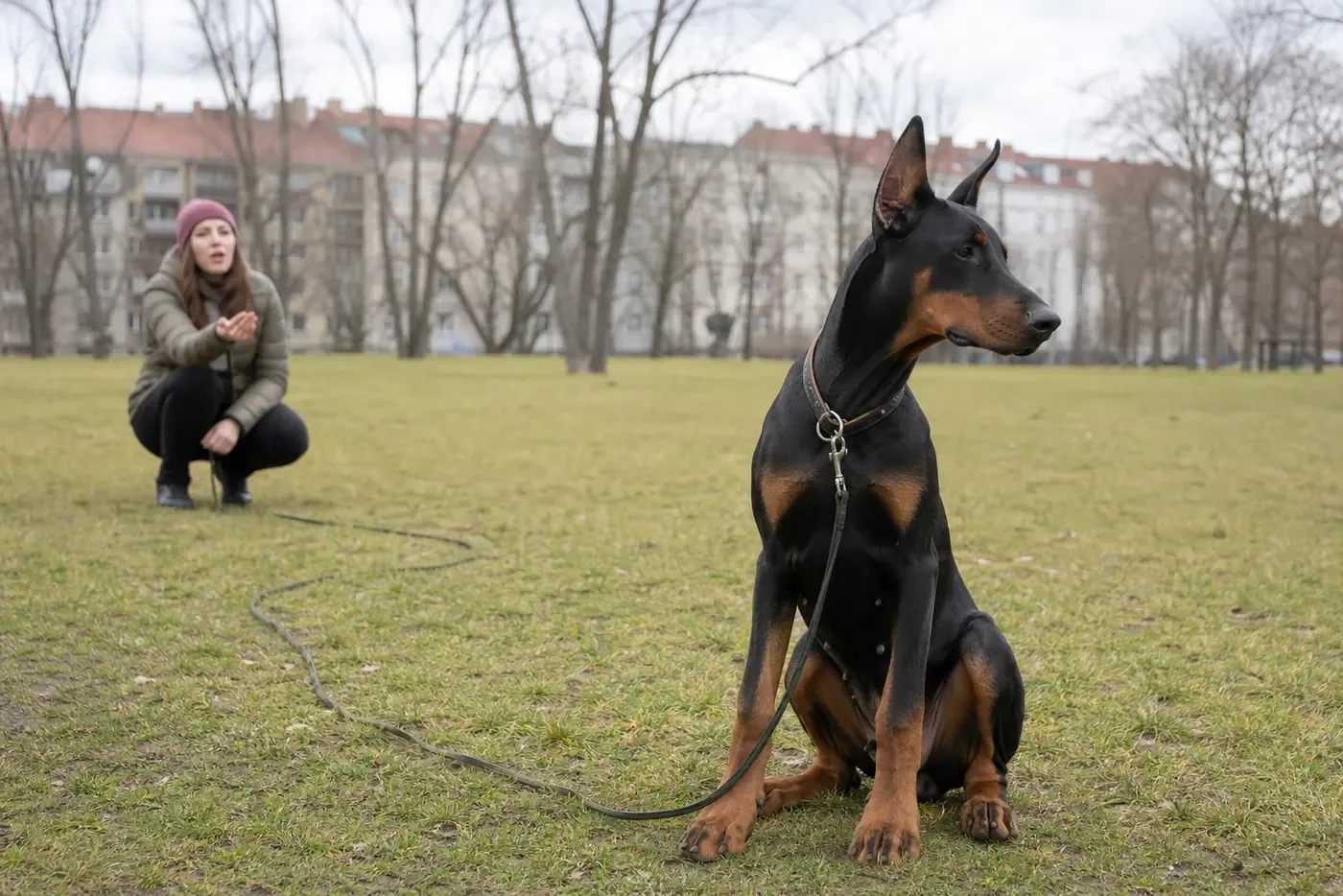
Canine adolescence is the developmental stage between roughly 6 and 24 months when sex hormones surge and the brain rewires itself, and from the outside it can look like an overnight personality swap. Somewhere around eight months, many owners of a promising young dog meet a stranger wearing their puppy's collar. The sit that was bulletproof is suddenly optional. The recall is a suggestion. The calm puppy now barks at a bin bag.
Nothing is broken. Adolescence is a real developmental stage in dogs, driven by the same machinery as human puberty: hormones surge, and the brain rebuilds itself. The prefrontal cortex, the region responsible for impulse control, is under construction exactly when the body is reaching full power, which is why veterinary behaviorist Dr. Pamela Perry describes adolescent dogs as impulsive and prone to overreaction until the rebuild finishes (Cornell University College of Veterinary Medicine).
For most dogs this stage starts between 6 and 12 months and ends around 18 to 24 months. If you own a Rottweiler, Cane Corso, Doberman, Pitbull, or Malamute, read on before you circle those numbers, because they were not written about your dog.
Why Did My Dog Suddenly Stop Listening to Me?
This is the question owners type into Google at 11pm, and it has one of the most satisfying answers in dog science. In 2020, researchers from Newcastle and Nottingham universities tested dogs at 5 and 8 months of age. At 8 months, in the thick of adolescence, dogs were more than twice as likely to repeatedly ignore a sit cue given by their own carer (odds ratio 2.14). The same dogs obeyed a stranger giving the same cue better than before (Asher et al., 2020 study).
Let that sink in: the disobedience is specific to you. The study also found the effect was strongest in dogs with insecure attachment to their carer, mirroring parent-teenager conflict in humans. Your adolescent dog is not untrained. It is renegotiating its relationship with the one person it is most bonded to, and the phase passes faster when you respond with consistency rather than escalation.
Practically, that means keeping sessions short, paying well, and quietly lowering criteria for a few months. The knowledge is intact; the brain accessing it is mid-renovation.
When Does Dog Adolescence Start and End?
The honest answer is a range, and size sets it:
| Size class | Adolescence starts | Behavioral maturity |
|---|---|---|
| Small and medium breeds | 6-9 months | 18-24 months |
| Large breeds (Doberman, Rottweiler) | 8-12 months | 24-30 months |
| Giant and molosser breeds (Cane Corso, Malamute lines) | 9-14 months | 24-36 months, sometimes later |
The American Kennel Club notes most puppies begin maturing between 6 and 9 months, but larger and giant breeds reach the stage later, with growth plates closing later too (AKC, 2026). Certified behavior consultant Cathy Madson goes further for the working end of the spectrum: livestock guardian types may not reach behavioral maturity until three or four years old (Preventive Vet, 2026).
Why Do Large and Giant Breeds Stay Adolescent Longer?
Two clocks run at different speeds in a big dog, and the gap between them is where owners suffer.
The physical clock finishes first. A Cane Corso at 18 months already has adult size, adult strength, and an adult bark that clears a pavement. The behavioral clock finishes much later. Growth plates in large frames stay open longer, and the impulse-control wiring lags behind even that. The result is a dog that looks completely mature and still makes teenage decisions, sometimes well into year three.
This mismatch is the entire reason big-breed adolescence is harder. A beagle that ignores recall for a season is an annoyance. A 50-kilo adolescent that ignores recall, or lunges at the wrong moment, is a liability, and the public judges it as a dangerous dog rather than a teenager. Every stake is higher: the strength, the stigma, the consequences of one bad incident. If your dog lives in a city flat on top of it all, our guide to living with a working breed in a small flat covers how to keep the pressure valve open at home.
Is My Dog Becoming Aggressive, or Is This Normal Adolescent Reactivity?
Almost always the second, but the distinction deserves care. Bark Busters' 2026 analysis of roughly 50,000 in-home training consultations found aggression and reactivity together are the largest category of inquiries nationwide, and their trainers stress that most of it is fear, frustration, or overstimulation that owners read as aggression. True aggression is a smaller subset (Bark Busters, 2026).
There is a breed-relevant wrinkle. A University of Pennsylvania study following 978 young dogs found German Shepherds, the guarding-type breed in the cohort, showed a significant rise in stranger-directed wariness specifically between 6 and 12 months (Serpell & Duffy, 2016 study). If a shepherd does that, expect some version of it in a Corso or Rottweiler. It is not a switch flipping to aggressive; it is guarding genetics coming online during the messiest phase of brain development.
Adolescence also brings fear periods: developmental stretches when a dog suddenly shows fear of things that never bothered it before, from bin bags to strange dogs, with timing that varies widely between individual dogs (Preventive Vet, 2026). Treat a spooky week as a cue to lower the pressure, not as a new personality.
The Penn study carries the most important warning in this article: puppies that were attacked or threatened by another dog before adolescence had 4.6 times higher odds of fear problems later. One bad dog encounter in this window compounds for years. That is the strongest argument there is for controlling who your adolescent dog meets. If reactivity has already taken root, our reactive dog socialization guide is the follow-up read.
Why Is Adolescence When Most Owners Give Up?
Because it arrives exactly when the cute wears off. The dog is huge, the training seems gone, walks have become work, and there is no puppy face left to forgive it all. Trainers and shelters keep seeing the same story: young dogs surrendered in exactly this phase, by owners who believed the regression was the destination rather than the road.
It is not permanent. Trainers call this the give-up window for a reason: the problems that get dogs rehomed, reactivity, destructiveness, unmanageability on a leash, all peak in exactly this phase, and owners who mistake the peak for the plateau stop fighting for the dog. Every method that got you through puppyhood still works; it just pays out slower for a while. The owners who make it through tend to share three habits: they manage the environment instead of testing the dog (long line instead of off-leash gambles), they keep training sessions short and frequent, and they do not take the phase personally. The dog on the other end of the leash at 20 months is not the finished dog. With a Corso or Malamute, the finished dog might still be a year away.
How Does Structured Socialization Help an Adolescent Big Dog?
The instinct many owners follow is to socialize harder: more dogs, more parks, more exposure. In adolescence that instinct backfires, because unstructured exposure is precisely where the high-stakes bad encounter happens, and the Penn data shows what one of those can cost.
What actually helps is the opposite: fewer dogs, chosen better. One or two calm, socially skilled, size-matched companions teach an adolescent how adult dogs behave, without the chaos that tips a teenage brain over threshold. Regular walks with the same well-matched dog build the kind of stable social confidence that survives adolescence, and they burn off the restlessness that fuels most teenage misbehavior. That is the job Fennaro does: it filters the neighborhood's dogs down to the calm, compatible ones, so the encounter your adolescent learns from is one you chose. If you are wondering whether your dog needs more canine company in the first place, we broke that decision down in does my dog need a friend.
When you do set up that first meeting, run it like a protocol: neutral ground, parallel walking, distance before contact. The full method is in our guide to introducing two big dogs safely.
What Should Big-Breed Owners Actually Expect, Year by Year?
Months 6 to 12: hormones arrive, recall wobbles, the carer-specific deafness begins. Start managing rather than testing. Months 12 to 24: peak teenage phase for large breeds. Strength is adult, judgment is not. Guard the quality of every dog encounter. Months 24 to 36: the fog lifts in stages. The Corso that embarrassed you at 20 months starts making eye contact and choosing you again.
The breed that tested you longest tends to bond deepest on the other side. Adolescence in a big dog is not a defect to fix. It is the price of the adult dog you wanted, paid in months of patience, and it is the phase where a few good, well-matched dog friendships do more for your dog's future than any amount of obedience drilling.
Common questions
When does dog adolescence end?
For most dogs, adolescence starts between 6 and 12 months and ends around 18 to 24 months. Large and giant breeds run later on both ends: behavioral maturity often arrives closer to 24 to 36 months, and some working and guardian types are not fully mature until three or even four years old. Size is the single biggest factor in the timeline.
Why did my dog suddenly stop listening to me?
It is a real, measured phase, not failed training. A 2020 study found adolescent dogs were more than twice as likely to ignore a sit cue from their own carer at 8 months than at 5 months, while obedience to strangers actually improved. The teenage brain is remodeling, and the conflict is aimed at the person the dog is most attached to. It passes.
Is my adolescent dog becoming aggressive?
Usually not. Trainers analyzing tens of thousands of consultations report that most of what owners call aggression in this phase is reactivity driven by fear, frustration, or overstimulation. True aggression is a smaller subset. That said, guarding breeds can show a real rise in wariness toward strangers between 6 and 12 months, so this is the age to manage exposure carefully.
How long does the teenage phase last in big breeds?
Budget for it lasting past the second birthday. Growth plates close later in large-frame dogs, and behavioral maturity lags even further behind physical maturity. A Cane Corso or Malamute can look like a finished adult at two and a half years and still make teenage decisions for months afterwards. Livestock guardian types can take until age three or four.
Did my dog forget its training?
No. The knowledge is still there, but the adolescent brain is temporarily worse at using it. Impulse control lives in the prefrontal cortex, which is being remodeled during this phase, so known cues lose out to distractions and hormones. Keep sessions short, keep rewarding, and lower your criteria for a few months instead of assuming the training failed.
Should I stop socializing my dog during adolescence?
No, but change how you do it. Unstructured exposure to random dogs is where adolescent reactivity is often born, because one bad encounter lands hard in this window. What helps is regular, calm contact with one or two well-matched, socially skilled dogs. Quality over quantity is the rule for the entire teenage phase.