- Introductions
- Body language
- Big breeds
How to Introduce Two Big Dogs Safely (The Calm Way)
On this page
TL;DR: The safest way to introduce two dogs is a parallel walk, not a nose-to-nose greeting on a tight leash. Start them 30 to 40 feet apart, walking in the same direction, and only close the gap across several sessions once both dogs relax. Skip the busy dog park for a first meeting, since one 2026 survey found more than 1 in 7 owners had a dog attacked at a public park. Most well-matched dogs need days, not minutes, before they actually settle around each other.
Why the First Meeting Sets the Tone
If you own a Cane Corso, a Rottweiler, or any dog built like a linebacker, you already know that one bad first impression is expensive. Not always in money (though vet bills happen), but in time. A dog that gets scared or overwhelmed at a first meeting can carry that memory for months, and every future meeting starts from a worse place than the last one ended.
This is not a small problem. Bark Busters' 2026 review of close to 50,000 in-home training inquiries found that reactivity and aggression, not obedience or house training, are the single largest category of concern owners bring to trainers (Bark Busters, 2026). Most of that reactivity traces back to fear and poor early experiences, not to breed or "bad temperament." A rushed introduction is one of the easiest ways to manufacture exactly that fear.
The good news: how you introduce two dogs matters more than which two dogs you're introducing. A calm, structured first meeting works whether it's a Doberman meeting a terrier or a Malamute meeting another Malamute. The method below is the same either way.
What Is a Parallel Walk, and Why Does It Work?
Forget the version where two dogs sniff each other at the end of a leash within the first thirty seconds. That's a gamble, and with big dogs the stakes are higher, because a bad reaction from 40kg of dog is a different kind of problem than one from 5kg of dog.
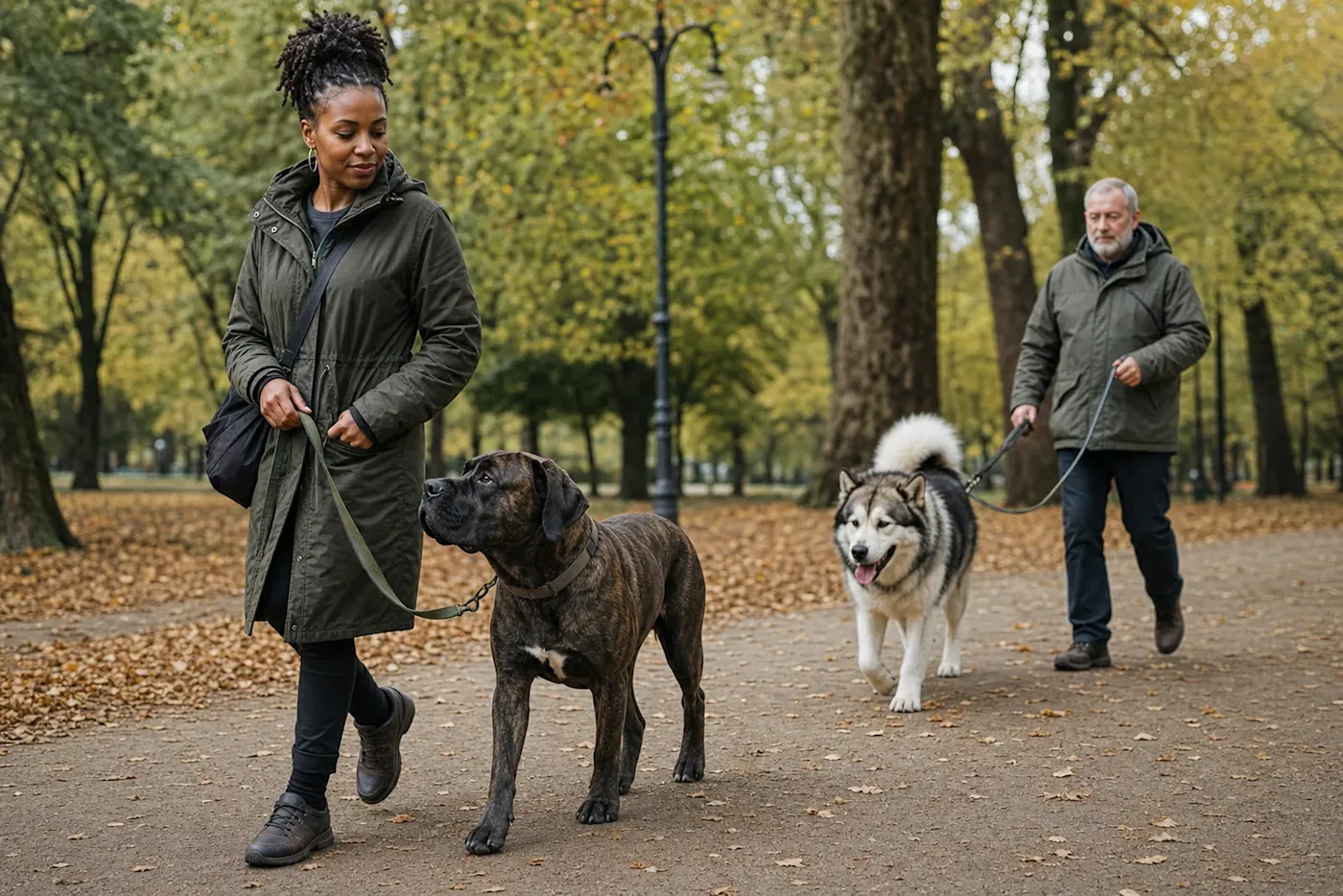
The parallel walk method sidesteps that gamble. Instead of a face-to-face greeting, both dogs walk in the same direction, well apart, so neither one has to commit to an interaction straight away. One trainer who runs parallel walk sessions daily keeps her goal modest: safe coexistence, not instant friendship. As she puts it, indifference is a win (Rescued By Training, 2026).
That reframe matters. Owners show up expecting their dogs to become fast friends in one session. They rarely do, and chasing that outcome is exactly what pushes people into forcing contact too soon. A parallel walk lets both dogs register each other's presence, relax their bodies, and build a small positive association (a treat, a calm voice) with zero pressure to greet.
How Far Apart Should Two Dogs Start?
Start further apart than feels necessary. The same parallel-walk method recommends beginning around 30 to 40 feet apart, then gradually closing that gap toward roughly 10 feet over multiple sessions, not one afternoon (Rescued By Training, 2026).
Two things matter more than the exact number on a tape measure. First, both handlers need slack in the leash. A tight leash transmits your own nerves straight down the line and tightens the dog's body too. Second, watch the dogs, not the distance: if either one stiffens, stares, or stops taking treats, you're still too close, whatever the measurement says.
If you're working with a big dog in a small flat, this step matters even more, since you likely don't have a garden buffer at home to fall back on. Our guide to keeping a working breed calm in a small apartment covers how that plays out day to day. For the practical side of the meetup itself (where to go, what to bring, how to end it early if needed), our safe big-dog meetup guide goes deeper.
What Calm Body Language Looks Like (and What Stress Looks Like)
This is the part people rush past, and it's the part that actually prevents fights. Body language shows up long before a growl does.
| Calm signals | Stress signals |
|---|---|
| Loose, wiggly body | Stiff, frozen body |
| Soft eyes, blinking normally | Hard stare, whale eye (whites showing) |
| Mouth open, relaxed | Mouth suddenly closed, lips tight |
| Tail loose, wagging in a wide arc | Tail tucked, or held high and stiff |
| Weight evenly balanced | Weight shifted back, leaning away |
| Sniffing the ground, shaking off | Repeated lip licking, yawning out of context |
| Approaching in a curve | Approaching in a straight line, head on |
Certified trainer Kaia Wilson (CPDT-KA) points out that reactivity signs are more common than most owners assume: her review of over 4,000 dog owners found 66% of dogs show some degree of reactivity (Sniffspot, 2026). That number matters here, because it means you should expect some stress signals during almost any first meeting and plan for them, rather than treating a single yawn as a dealbreaker. One stress signal is information. Three or four stacked together, in a dog that's also stiff and staring, is your cue to add distance now.
Introducing a Large Dog to a Smaller Dog Safely
Size gaps deserve their own section, because the math changes. A 45kg Cane Corso and a 6kg terrier can both have good intentions and the meeting can still go wrong, since play that looks normal to the big dog (a shoulder check, a mouth grab at the ruff) can injure the smaller one by accident.
The clearest rule here comes from a widely used introduction guide: never allow unsupervised play once the size difference passes about 30 pounds (roughly 13-14kg), until you're completely confident in how both dogs communicate (Dog Notebook, 2026). That's not a one-time supervision either. It means every session, for a while, has a human close enough to physically step in.
In practice: keep the big dog on a shorter leash near a small dog (not tight, just shorter), let the small dog set the pace for how close it wants to get, and end the session the moment either dog seems overwhelmed rather than waiting to see how it plays out. A good first meeting between mismatched sizes often looks boring: both dogs mildly aware of each other and nothing more. Boring is the goal.
Why Busy Dog Parks Are the Wrong Place for a First Meeting
A packed public dog park feels like an easy shortcut: plenty of dogs, no appointment needed. It's also close to the worst possible venue for a first introduction, because you control none of the variables. You don't know the other dogs, can't guarantee a quiet retreat route, and can't stop a strange dog from rushing straight at yours.
The numbers back up what most big-dog owners already suspect. A 2026 Sniffspot survey of dog owners found more than 1 in 7 reported their dog had been attacked at a public dog park (Sniffspot, 2026). One bad encounter is enough to create lasting fear or reactivity, especially in a dog that learns fast from a single event, which describes plenty of working breeds.
Use a quiet, neutral space instead: an empty field, a rented private yard, a calm side street at a low-traffic hour. None of those need a park full of strangers, and all of them let you control distance, which is the entire point of everything above. For readers in Poland, our guide to neutral places to walk a big dog in Kraków lists quiet places that work for exactly this kind of first meeting.
How Long Does It Take for Two Dogs to Get Along?
Slower than owners want, usually. A single calm parallel walk can be enough for two easygoing adult dogs to tolerate each other fine on a second meeting. For dogs who will actually share a home, trainers commonly describe a 3-3-3 adjustment window: roughly three days for the new dog to be overwhelmed and quiet, three weeks for its real personality and boundary testing to show up, and three months before it's fully settled and bonded (Dog Notebook, 2026).
That timeline is a guideline, not a guarantee, and rescues with a rough history can take longer. The practical takeaway stays the same either way: judge progress across multiple sessions, not one walk. If session three looks like session one, that's useful information, not automatically a failure, and it usually means more distance or more time is needed before closing the gap further.
What to Do If the First Meeting Goes Wrong
Sometimes it goes wrong anyway. A dog you thought was calm suddenly stiffens, or a stranger's off-leash dog barrels in before you can react. Here's what actually helps in the moment: increase distance first, loosen your own grip on the leash second (tension there feeds tension in the dog), and remove one dog from the situation calmly rather than yanking or shouting, which tends to spike arousal further.
Afterward, don't rush a second attempt just to prove the first one was a fluke. Go back to a bigger starting distance than before and rebuild from there. If your dog is showing ongoing stress around other dogs rather than a one-off bad moment, our guide to socializing a reactive dog walks through the slower process that actually works for dogs already carrying some fear.
This is also the exact problem Fennaro was built around: matched, structured introductions between dogs of a similar size and temperament, instead of dog-park roulette with strangers you know nothing about. If you'd rather start every first meeting with better odds, see how it works or head back to the homepage to learn more.
Common questions
How do I introduce my dog to another dog for the first time?
Introduce them on neutral ground, not in either dog's yard or home. Start with a parallel walk: both dogs on loose leashes, moving the same direction, 30 to 40 feet apart. Let them notice each other without forcing contact, then close the distance over several minutes. Only let them meet nose to nose once both dogs stay loose and calm.
What is the parallel walk method?
It's a way to introduce dogs side by side, well apart, heading in the same direction instead of meeting face to face. It lowers pressure because neither dog has to greet head on. Handlers reward calm glances at each other, then close the gap gradually across a few sessions until the dogs can walk close together relaxed.
How far apart should two dogs be when meeting for the first time?
Start further apart than feels necessary, around 30 to 40 feet, so both dogs can notice each other without tensing up. Watch their bodies, not the tape measure: if either dog stiffens, stares, or stops taking treats, you're still too close. Only shrink the gap once both dogs stay loose at the current distance.
How long does it take for two dogs to get along?
Some dogs settle within a single calm walk. Most need several sessions across days or weeks before they're comfortable sharing space unsupervised. For dogs moving in together, trainers often reference a three days, three weeks, three months timeline before a new dog fully decompresses and shows its real personality at home.
Is it okay to introduce dogs at a dog park?
A busy public dog park is a poor choice for a first meeting. There's no control over which dogs approach, no easy retreat if one dog gets overwhelmed, and a single bad encounter there can create fear or reactivity that lasts. Use a quiet neutral space instead, like an empty field or a calm side street.
What are the warning signs an introduction is going badly?
Watch for a stiff, frozen body, a hard stare, raised hackles, a tucked tail, or a mouth that suddenly clamps shut. Growling and snapping are late warnings, not the first ones. If you see these signs, add distance immediately, keep the leash loose, and end the session calmly rather than pushing through it.