- Dog meetups
- Big dogs
- Dog safety
How to Run a Safe Big-Dog Meetup in Your City
On this page
TL;DR: A safe dog meetup for big and working breeds needs a capped group size, screened dogs and owners, neutral ground, and clear rules about greetings. Professional dog walkers cap groups at four to six dogs per handler, and that number matters more once you're dealing with 40kg dogs instead of 8kg ones. Skip the open dog park roulette, build a structured meetup instead, and a rough moment stays a rough moment instead of an emergency vet bill.
If you own a Cane Corso, Rottweiler, Doberman, Malamute, or a big mixed breed, you already know the calculus is different. A scuffle between two Chihuahuas ends in a yelp and hurt pride. The same scuffle between two 45kg dogs can end in stitches, and that changes every decision you make about who your dog meets and where.
Why Random Dog Park Meetups Go Wrong for Big Dogs
Open dog parks feel like the obvious answer. Fenced, free, full of dogs, what could go wrong. Quite a lot, actually. Vet-reviewed guidance on dog park alternatives points out that dogs do not always get along any better than people do, and when a disagreement happens in a crowd of strangers, nobody there knows your dog's triggers or your dog's history. The same piece flags disease transmission as a real cost of open parks: unvaccinated dogs, puppies too young for full protection, and immunocompromised dogs all mixing in the same few square meters of grass.
Add size into that mix and the stakes change again. A snap between two similarly sized dogs who both back off is a non-event. A snap from a 45kg dog that connects is a different category of injury than the same snap from a small terrier, even when the intent behind it is identical. None of this means big dogs are more dangerous by nature. It means the margin for error at a size where a correction can cause real damage is thinner, and a random dog park gives you zero control over who shows up.
What Group Size Actually Keeps a Walk Safe?
This is where most informal meetups fail before anyone even notices. A Facebook group posts "meet at the park, all dogs welcome," fifteen people show up, and now you have a dozen unfamiliar dogs in one space with no plan. Compare that to how professional dog walking services actually operate.
| Open Dog Park / Unmanaged Group | Structured Meetup | |
|---|---|---|
| Group size | Uncapped, whoever turns up | Capped, usually 4-6 dogs |
| Screening | None | Owners share temperament and history first |
| Supervision | Attention split across a crowd | One handler watching a small group |
| First contact | Nose to nose, on arrival | Parallel walk before any greeting |
| Best fit | Confident, dog-social dogs only | Big, working, or reactive dogs |
The four to six figure isn't arbitrary. It's the ratio professional dog walking services use to keep individual dogs from getting lost in the crowd, and it holds up for owner-run meetups just as well. Past that number, sensory overload sets in fast, especially for a breed built for focus and work rather than a free for all.
How to Screen Dogs and Owners Before They Join
A good meetup starts before anyone's paws touch the ground. The same UK dog-walking research lists the absence of temperament checks, missing insurance or first-aid awareness, and incompatible pack composition (no matching by size, age, or energy) among the clearest red flags of an unsafe walking group. Owners running their own meetup can apply the same standard without hiring anyone.
Before you agree to add a new dog to the group, ask direct questions: how does this dog react to being approached head-on, has it ever needed to be separated from another dog, does it guard food or toys, is it neutered, is it up to date on vaccinations. None of these questions are rude between people who actually care about their dogs. If an owner gets defensive at being asked, that tells you something too.
For dogs with a known reactivity history, a group setting is often the wrong first step entirely. Our guide on how to socialize a reactive dog walks through building confidence one calm introduction at a time before a dog is ready for anything resembling a group.
Choosing Neutral Ground
Where you meet matters almost as much as who shows up. A dog's own yard or a park it visits daily carries territorial weight that raises tension before anyone has even said hello. Neutral ground, an open field neither dog knows well, a quiet section of trail, or an empty car park, removes that layer of pressure entirely.
Trail-based meetups add their own etiquette on top. Trail safety guidance for hiking with dogs recommends staying to one side of the path, stepping aside for other trail users, and keeping leashes short enough that they never stretch across the path where a cyclist or runner could catch a leg in one. For a meetup of big dogs specifically, that discipline matters even more, because a tangled leash involving a 40kg dog is a genuinely different hazard than the same tangle with a spaniel.
Pick ground with enough open space that dogs can move away from each other if they need to. A narrow trail or a tight parking strip removes exactly the option a nervous dog needs most: distance. Our guides to shared walks with a big dog in Kraków, Warsaw and Wrocław cover the specific spots that give you that room, and the local rules that apply in each.
Rules That Keep a Big-Dog Meetup Calm (No Nose-to-Nose Greetings)
The single biggest mistake in group dog walks is letting dogs greet face to face the moment they arrive. Trainers working with reactive dogs describe how proximity, chaos, and unpredictability push a dog past its coping point, and once a dog is over that threshold, learning and calm behaviour both switch off. A frontal, nose-to-nose greeting between two dogs who have never met is one of the fastest ways to trigger exactly that state, and it happens constantly at unmanaged meetups because it looks friendly.
A calmer structure looks like this instead:
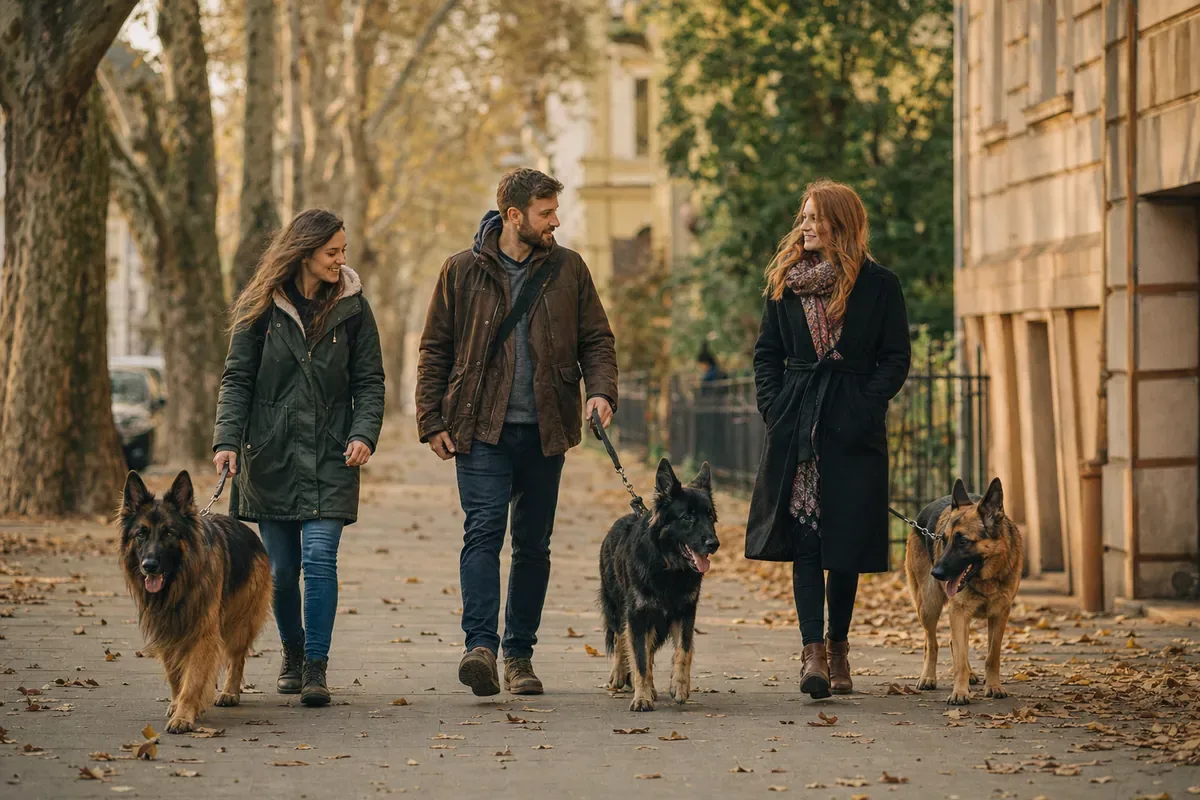
- Start with a parallel walk, dogs on either side of their owners, several meters apart, moving in the same direction.
- Let the gap close gradually over five or ten minutes only if both dogs stay loose and relaxed.
- Allow greetings at an angle, side by side, never head-on.
- Keep initial greetings under five seconds, then call the dogs away and keep walking.
- Watch for stiffening, a fixed stare, or a raised tail rather than waiting for an actual growl.
None of this is complicated. It just requires someone in the group to actually enforce it instead of assuming every dog will sort it out on their own.
Why Honesty About Temperament Beats "Friendliness"
Every owner thinks their dog is friendly, and most of the time they're right, right up until a specific trigger they've never seen before shows up. "He's friendly" is not useful information at the gate of a meetup. What's useful is specifics: how the dog handles being crowded, how it does around dogs twice its size, whether it has ever needed space after a bad interaction, whether it prefers dogs that mirror its own energy or play style.
This is exactly the gap that structured, profile-based matching closes better than a group chat ever can. Fennaro exists because "friendly" doesn't scale past a handful of dogs, so instead of hoping a big meetup sorts itself out, owners build a real dog profile (size, energy, temperament notes) and get matched with dogs that are actually compatible before a first meeting ever happens. You can see how that works at fennaro.com if group chats have burned you before.
The same honesty matters when you're introducing two dogs one on one rather than in a group. Our step by step guide on how to introduce two dogs safely covers the same idea in more depth: slow, structured, and led by what the dogs are actually telling you, not by how confident their owner sounds.
What to Do When a Dog Needs to Sit Out
Sometimes the right call is pulling a dog out of the walk entirely, for that day or for good. A dog that's stiff, over-aroused, guarding, or just having an off day doesn't need to push through a meetup to prove anything. Sitting out isn't a failure, it's the same judgment call a good trainer makes constantly, and a meetup organizer who never asks a dog to step back is one who hasn't been paying close enough attention.
This matters even more for big and working breeds living in tighter urban spaces, where a single bad interaction can sour a dog on group walks altogether. If your dog's daily world is already a small flat, our guide on big dogs in small apartments has more on managing energy and stress day to day, which feeds directly into how a dog copes at a group meetup too.
A safe big-dog meetup isn't about finding the perfect group of strangers on the first try. It's a capped size, honest screening, neutral ground, calm introductions, and the willingness to pull a dog out when it needs it. Get those five things right and the rest tends to take care of itself. If you'd rather skip the group-chat guesswork altogether, Fennaro matches dogs by size and temperament before you ever agree to meet up.
Common questions
How many dogs should be in a safe group walk?
Most professional handlers cap a group at four to six dogs, and that ratio holds up for big or working breeds too. Beyond that number nobody can watch body language closely enough. Two or three well matched dogs on a calm walk beats a crowded pack every time.
Is it safe to bring a reactive dog to a group walk?
Usually not a large, unscreened one. Reactive dogs need controlled, predictable exposure, and a busy pack walk is neither. A one on one parallel walk with a carefully chosen dog, kept under threshold with an exit always available, works far better than a crowd.
What should I look for before joining a dog meetup group?
Ask how dogs get matched by size and temperament, whether new members are vetted before showing up, and what happens if two dogs do not get along. A group with no screening, no size cap, and no clear rules is a warning sign, not a welcome mat.
Where is the best neutral ground for a dog meetup?
An open field, quiet trail, or empty parking lot beats any dog's home turf or a small fenced park. Neutral ground removes territorial pressure, gives dogs room to move apart, and lets owners watch how two dogs behave before they are close enough to touch noses.
Do dogs need to be leashed during a pack walk?
Yes, at least until everyone has proven they listen around other dogs off leash. A long line gives a big dog room to move naturally without losing control if something startles it. Drop the leash only once the group has walked calmly together more than once.
What are dog park alternatives for big or reactive dogs?
Structured meetups with a capped, screened group beat an open dog park for most big or reactive dogs. Sniff walks on a long line, one on one introductions on neutral ground, and matched playdates through an app all give more control than a fenced free for all.