- Training
- Walks
- Behaviour
Why Is My Dog So Excited Around Other Dogs?
On this page
TL;DR: A dog too excited around other dogs may be a friendly frustrated greeter. The dog wants access, the lead prevents it, and arousal spills into pulling, whining, jumping or barking. Stop automatic greetings, work at a distance where your dog can still think, reward calm observation and practise leaving. First rule out fear, pain and aggression because they need a different safety plan.
Some of the hardest dogs to walk are genuinely friendly. They spot another dog, lean into the lead and stop hearing everything else. A few seconds later they are bouncing, squealing or barking so intensely that the other owner assumes aggression.
Calling the dog friendly does not make the behaviour harmless. A powerful dog can pull a person over, frighten another dog or turn a greeting into conflict. The useful goal is not to suppress enthusiasm. It is to teach the dog that seeing another dog does not guarantee contact, and that calm choices keep everyone safe.
Is your dog excited, frustrated, fearful or aggressive?
Similar outward behaviour can come from different emotions. A frustrated greeter often has a history of enjoying other dogs and trying to reach them. The body may be loose at first, with a wagging whole body, play bows, whining and forward movement. Tension rises when access is blocked.
A fearful dog may lean away, lower the body, tuck the tail, avoid looking directly or scan for escape before lunging to create distance. Defensive aggression can include hard staring, freezing, a closed mouth, weight forward and a rapid escalation when another dog approaches. Real dogs can show mixed signals. A dog can want contact and feel worried at the same time.
The American Kennel Club guide to dog greetings advises teaching space-making skills and attention before practising around other dogs. Do not use an on-lead greeting to test which emotion is present. If you are uncertain, create distance and ask a qualified professional to observe.
Our reactive-dog socialisation guide covers fear-based and broader reactive behaviour. This article focuses on the social dog whose frustration appears when greeting or play is prevented.
Why does the lead make friendly excitement worse?
The lead removes choice. The dog cannot approach naturally, curve away or create distance without the handler. If pulling has sometimes ended in a greeting, pulling has also been rewarded. On days when access is refused, the expected outcome disappears and frustration increases.
The cycle often looks like this:
| Moment | Dog's expectation | What the dog learns |
|---|---|---|
| Sees another dog | “We are going to meet” | Other dogs predict immediate access |
| Pulls and reaches the dog | Greeting happens | Pulling works |
| Pulls but is held back | Frustration rises | Barking or jumping may be tried next |
| Handler sometimes gives in | Greeting finally happens | More intense behaviour can work |
This is not stubbornness or a bid for dominance. The behaviour has a history and an emotional component. Punishing the dog near other dogs can add pain or fear to an already intense picture. The AVSAB position on humane dog training recommends reward-based methods and warns against aversive approaches that create welfare and behavioural risks.
The solution is a new predictable pattern: notice, stay within a manageable level, reconnect with the handler and move on. Occasional selected greetings can return later, but they should not be the automatic payment for pulling.
What are the earliest signs of overarousal?
Intervene before barking. The first signs may be subtle: walking faster, closing the mouth, holding the breath, raising the tail, fixing the gaze or ignoring a familiar sniff spot. The dog may still take food but grab it hard. Response to a known cue becomes slower.
Later signs include leaning continuously into the lead, whining, hopping, spinning, vocalising and refusing food. At that point, asking for a long sit or repeated eye contact often adds frustration. The dog needs space, movement and recovery, not a harder obedience test.
The Dogs Trust guide to canine stress signals describes changes in posture, facial expression and normal behaviour that can reveal rising stress. Learn your own dog's sequence. A short video recorded from a safe distance can help a behaviour professional identify the moment the dog stops coping.
Large dogs deserve an earlier response because a small increase in arousal can quickly become physically difficult to manage. Cross the street while your dog can still follow rather than waiting to prove they can pass at two metres.
At what distance can your dog still learn?
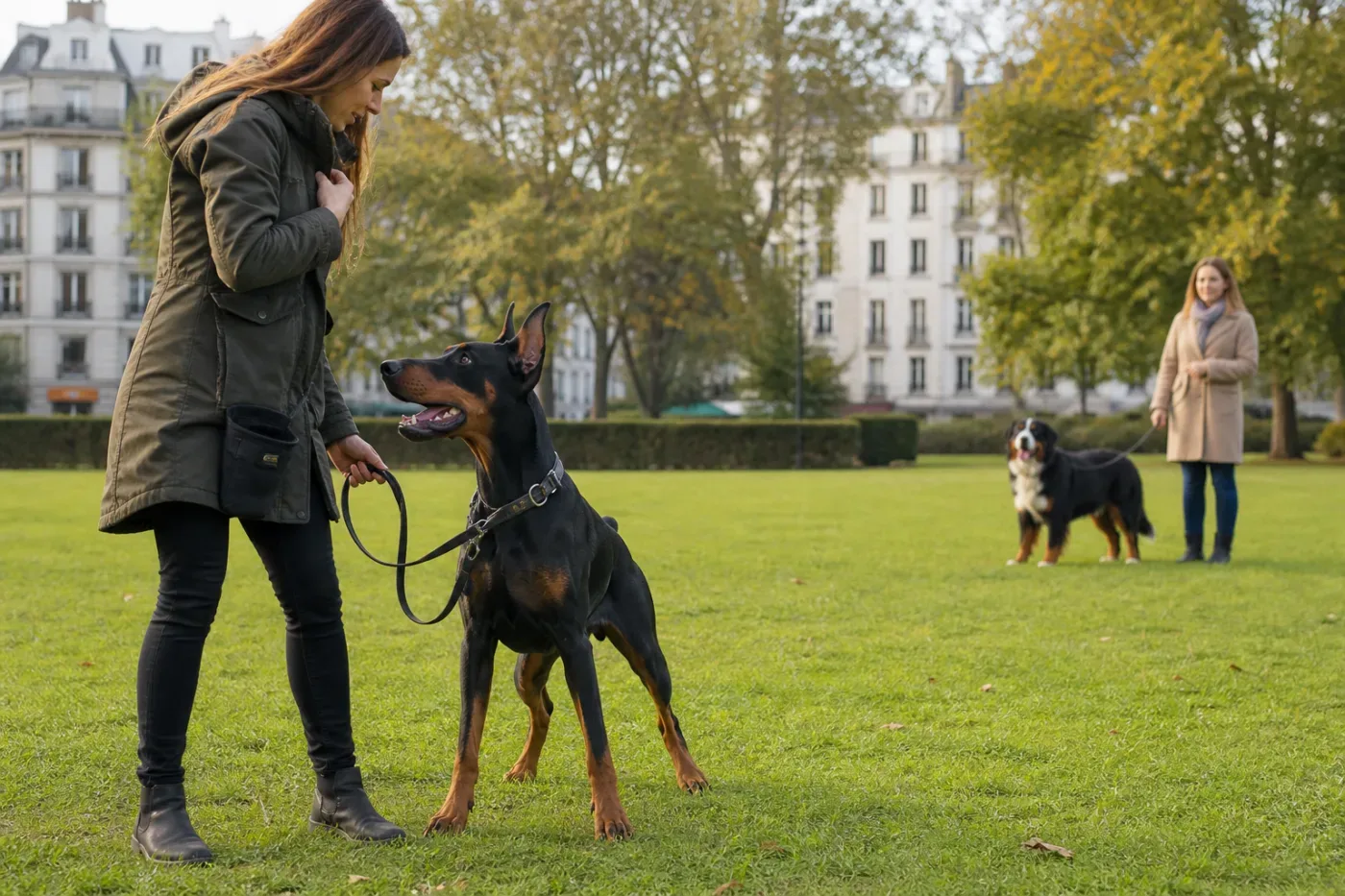
Find the distance where your dog notices another dog but can also sniff, eat a normal treat and turn with you. This is a working distance, not a fixed number. It changes with location, movement, surprise, the other dog's behaviour and your dog's sleep or pain that day.
Start in an open place with an escape route. When your dog looks at the distant dog, mark the observation with a calm word and place food near your leg or slightly behind you. Feeding behind creates a natural turn away. Then walk off in a gentle curve.
If your dog cannot eat food they normally love, stares without disengaging or surges forward, increase distance immediately. Do not wave food against the nose while moving closer. That can conceal rising stress without changing it.
The Dogs Trust reactive-dog guidance explains that overarousal and lead frustration can produce barking and lunging. A parked car, hedge or wide side street can act as a visual barrier during real walks.
How do you teach calm passing step by step?
Practise the component skills without dogs first. Teach a cheerful turn cue, a hand target and a pattern of taking food by your side. These are exit tools, not commands used to trap the dog in place.
Then use controlled setups:
- Begin at a distance where the other dog is visible and your dog remains loose.
- Reward one or two calm glances, then move away before fixation.
- Walk parallel to a calm helper dog, both travelling in the same direction.
- Close the gap only when both dogs can sniff and respond normally.
- Vary the outcome. Sometimes turn away, sometimes pause, sometimes continue parallel.
- End after a few successful passes rather than pushing until the dog erupts.
The AKC explanation of leash lunging describes frustration as one cause and supports management that prevents rehearsal. Every uncontrolled lunge strengthens the pattern, so quiet routes are part of training, not avoidance of training.
Progress is visible when recovery becomes faster and the dog can make a wider range of choices. A perfect close pass is not required. Calmly crossing the road may be the correct lifelong choice.
Should your dog ever greet another dog on lead?
On-lead greetings are optional. Many dogs are more comfortable walking together than meeting nose to nose. A tight lead restricts natural curves and can send tension through both handlers.
If both owners want a greeting, first walk in the same direction with space between the dogs. Look for loose bodies, curved approaches and the ability to disengage. Keep the first sniff brief, call the dogs apart and reward. A good greeting can end after two or three seconds.
Do not proceed when either dog freezes, hides behind the handler, pins the other dog with a stare or cannot turn away. Size difference also matters. Friendly impact from a large adolescent can injure a smaller or older dog.
Our guide to introducing two dogs safely provides a full neutral-ground sequence. If play follows, read the signs in are dogs playing or fighting?, especially pauses, role changes and consent after interruption.
How can planned dog time help without rewarding pulling?
A social dog may still need suitable contact. The answer is planned access, not random access. Choose a compatible dog with a calm handler, enough space and a play style that does not overwhelm either participant.
Begin with a parallel walk. Let arousal settle before considering closer contact. If you release the dogs in a secure permitted area, interrupt early for short breaks. Both should choose to return. End while play remains balanced.
Avoid using a crowded dog park to “wear the dog out.” Repeated high-arousal entry, chasing and uncontrolled greetings can make the sight of dogs even more exciting. Physical exhaustion also does not teach the skill of passing calmly on a lead.
The PetMD introduction guide recommends neutral territory, parallel movement and careful observation rather than immediate contact. Structured sessions make the rule clear: sometimes a calm approach leads to social time, and sometimes seeing a dog simply leads to moving on.
What should you do when your dog is already barking and lunging?
Stop asking for stillness. Hold the lead securely without wrapping it around your hand, turn your body away and create distance. Use a parked vehicle, hedge or entrance as a visual barrier. Scatter a few treats only if the dog can safely search and there is no conflict with scavenging or nearby dogs.
Do not scold, jerk the lead or force a close pass. Get out, allow recovery and make the next exposure easier. After a major reaction, a quiet sniffing walk or rest may be more useful than another training attempt.
Equipment should fit and protect the handler's control, but tools do not teach neutrality by themselves. A front-attachment harness may help some teams while twisting or rubbing others. A muzzle can reduce bite risk in an appropriate plan but does not make greetings safe. Fit and train every item before relying on it.
When does friendly excitement need professional help?
Get support when the dog is too strong to hold safely, reactions are getting more intense, recovery takes many minutes, signals are mixed or there has been contact, snapping or a bite. Pain can lower tolerance, so a veterinary check belongs in the plan when behaviour changes suddenly.
Choose a reward-based trainer or clinical behaviour professional with experience in leash frustration. They should ask about triggers, distance, recovery, health and the dog's history before proposing close contact. Avoid anyone who promises a rapid cure through intimidation or deliberately provoking the dog.
Friendly frustration improves through many ordinary repetitions below the explosion point. Teach your dog that noticing another dog can lead to food, movement, space and sometimes carefully chosen social time. Neutrality does not remove sociability. It gives the dog enough control to use it safely. To arrange more compatible, structured walks, get Fennaro.
Common questions
Why does my friendly dog go crazy when seeing other dogs?
A social dog can become overaroused because seeing another dog predicts access to play or greeting. When the lead blocks that access, excitement can turn into frustration, pulling and barking. Fear can look similar, so judge the full body language and the dog's history, not enthusiasm alone.
Should I let my dog greet every dog on walks?
No. Greeting every dog can teach your dog that pulling is the route to access and make disappointment harder when a greeting is unsafe. Aim for calm neutrality first. Allow selected greetings only when both dogs and handlers agree, the leads are loose and either dog can leave.
How do I stop my dog pulling toward other dogs?
Begin far enough away that your dog can notice the other dog and still eat, respond and move with you. Reward calm observation and turning away, then leave before excitement escalates. Reduce distance gradually across sessions. Do not drag the dog close to practise self-control.
Is an excited dog the same as a reactive dog?
Excited dogs can display reactive behaviour such as lunging or barking, but the underlying emotion may be social frustration rather than fear or defensive intent. The label matters less than safety and distance. A professional should assess mixed signals, rapid escalation or any bite history.
Can more dog play fix a frustrated greeter?
Appropriate play can meet social needs, but unlimited greetings rarely teach calm passing. Practise being near suitable dogs without always gaining access. Use planned parallel walks and short, mutual play with breaks. The dog should learn that seeing another dog can also predict checking in and moving on.
When should I get professional help for overexcitement?
Seek qualified help if you cannot hold the dog safely, reactions intensify, recovery takes a long time, body language is unclear or there has been snapping or biting. A veterinarian should first consider pain or medical contributors. Choose a reward-based professional experienced with leash reactivity and large dogs.