- Polish law
- Breed list
- Big breeds
Dangerous Dog Breeds in Poland: The List and Permit Rules
On this page
TL;DR: Dangerous dog breeds in Poland are a closed list of 11 breeds set by a 2003 regulation that has never been amended. Only two are common: the Rottweiler and the American pit bull terrier. The Cane Corso, Doberman, Malamute, and Amstaff are NOT on it, no matter what global listicles claim. Nothing is banned: listed breeds need a permit from the local mayor's office for 82 zloty. Separately, the 2026 KROPiK law will require chipping and registering every dog by around 2028. Here is what the law actually says, in plain English.
Which dog breeds are actually restricted in Poland?
Poland's list comes from a regulation of the Minister of Internal Affairs dated 28 April 2003, and it has survived 23 years without a single amendment (Dz.U. 2003 nr 77 poz. 687). The full list of breeds "considered aggressive":
- American pit bull terrier
- Perro de Presa Mallorquin
- American Bulldog
- Dogo Argentino
- Perro de Presa Canario
- Tosa Inu
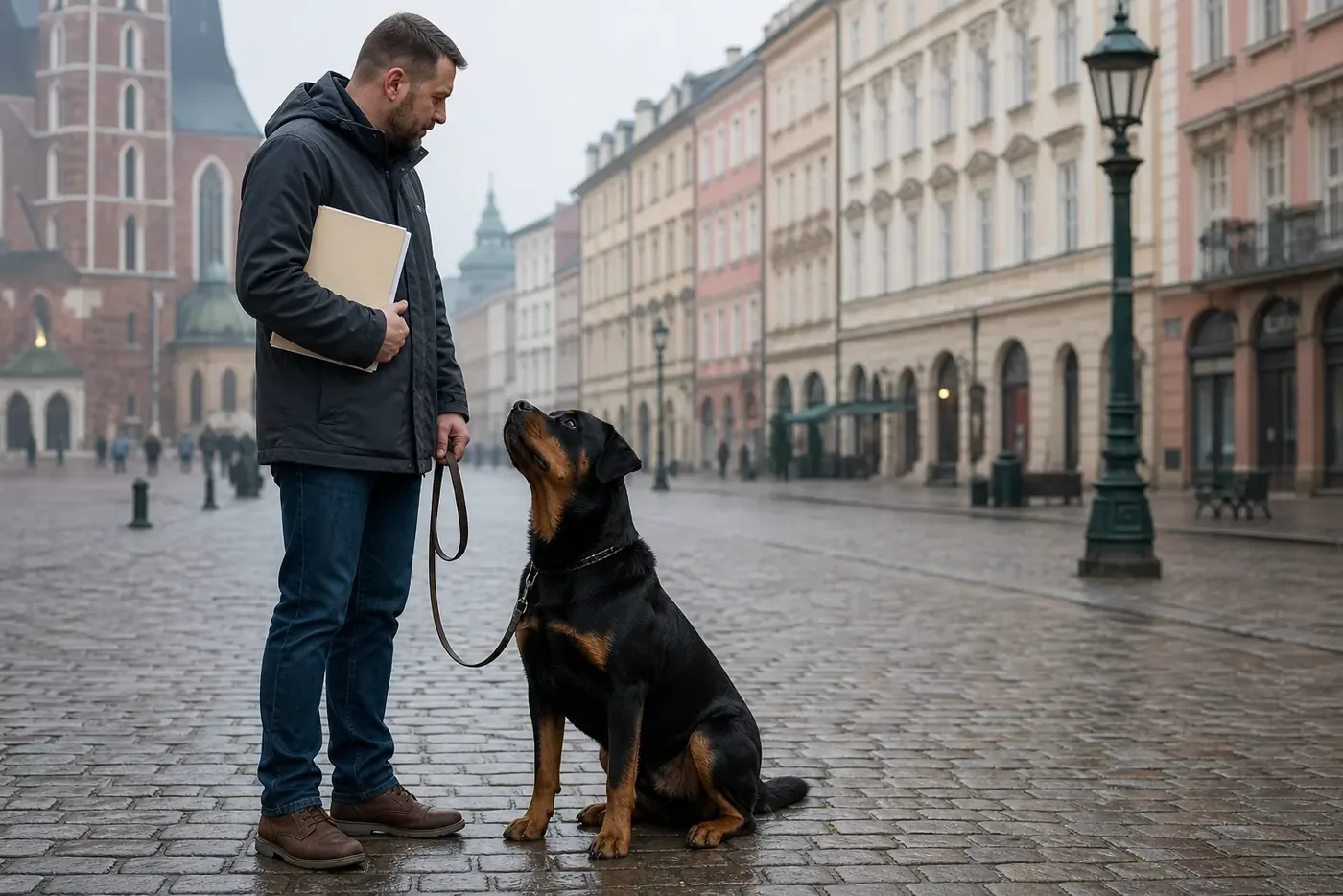
- Rottweiler
- Akbash Dog
- Anatolian Karabash
- Moscow Watchdog
- Caucasian Shepherd Dog
Read it twice, because what is missing matters more than what is there. Most of the breeds foreign owners worry about simply are not on it. And note the legal framing: these are breeds "considered aggressive" for permit purposes, a legal category, not a behavioral verdict on any individual dog.
Is my Cane Corso, Doberman, or Malamute restricted in Poland?
No. None of the three appears on the list, and neither does the American Staffordshire Terrier, which people constantly confuse with the listed pit bull terrier (they are separate breeds in the FCI classification). Here is the quick reference for the breeds expats ask about most:
| Breed | On Poland's list? | Permit needed? |
|---|---|---|
| Rottweiler | YES | Yes, 82 zl, before you get the dog |
| American pit bull terrier | YES | Yes, 82 zl, before you get the dog |
| Cane Corso | NO | No |
| Doberman | NO | No |
| Alaskan Malamute | NO | No |
| American Staffordshire Terrier | NO | No |
| Presa Canario | YES | Yes |
| Caucasian Shepherd | YES | Yes |
The misinformation problem here is real. Global "banned dog breeds by country" listicles dominate the search results for this topic and routinely blur the UK's XL Bully ban, France's category system, and Germany's import rules into one scary paragraph, sometimes attaching breeds to Poland that Poland has never restricted. The primary law is short and public. Trust it over aggregators.
The Amstaff case deserves one extra beat, because even officials get it wrong. The list names the "American pit bull terrier." The American Staffordshire Terrier is a separate breed in the FCI classification, with its own standard and its own registry entries, and it appears nowhere in the regulation. Similar name, similar silhouette, different legal status. If someone at the dog run insists your Amstaff needs a permit, the regulation is one link away and it is eleven breeds long.
What do you actually have to do to keep a restricted breed in Poland?
If your dog genuinely is on the list, the procedure is a permit, not an obstacle course. The official service description lives on biznes.gov.pl:
- Apply to the wójt, burmistrz, or city president for the municipality where the dog will live. The application covers your details, the dog's breed, sex, name, birth date, its marking or chip, and a description of the conditions it will be kept in.
- Pay the fee: 82 zloty for private ownership, 616 zloty for breeding, plus 17 zloty if a proxy files the application.
- Expect a visit. The office typically inspects whether the dog will be kept in conditions that pose no danger to people or animals, because that is the substantive condition for granting the permit.
- Wait up to a month, or two in complicated cases.
One practical point confirmed by fresh case law: you can and should apply before acquiring the dog. In February 2026 the regional administrative court in Łódź ruled that an office cannot refuse to process an application just because the applicant could not yet name a specific dog they only intend to acquire (Lege Artis, 2026). Paper first, puppy second.
Keeping a listed breed without the permit is a misdemeanor punishable by a fine, and in extreme cases a court can order forfeiture of the dog. A separate provision, Article 77 of the Misdemeanor Code, fines any owner of any dog up to 1000 zloty for failing to take ordinary precautions, like letting a dog off leash where local rules require one.
What rules apply to every big dog in Poland, listed or not?
Three things catch newcomers out, because none of them lives in a national statute:
- Municipal regulations. Leash rules, and sometimes muzzle rules for specific categories of dogs, are set by each gmina in its cleanliness and order regulations. Administrative courts have upheld municipal requirements like warning signs and muzzles for listed breeds. Kraków, Warsaw, and Wrocław each write their own details, so check your city, not the country.
- Civil liability. You answer for damage your dog causes under the Civil Code regardless of breed. There is no mandatory dog liability insurance in Poland, but voluntary private liability cover costs little and makes obvious sense with a 40-kilo dog.
- The stigma is ahead of the law. Poland is a proudly big-dog country in its cities, but a Cane Corso owner will still be told at the dog run that their dog "is on the list." It is not. Knowing the actual list is half the peace of mind.
What changed in Poland's dog laws in 2026?
Two new laws, and neither touches the breed list, which is worth stating clearly because coverage often mixes them together.
KROPiK, the national register of marked dogs and cats, was signed by the president on 2 June 2026. It makes microchipping and registration mandatory for all dogs, with costs capped at 50 zloty for the chip and 50 for registration, and already-chipped dogs registered free for the first three years. The registry has a 24-month build period, so full rollout lands around mid 2028 (psiadwokat.pl, 2026). Fines for non-compliance will range from 20 to 5,000 zloty once the system is live, a ceiling the president himself publicly called too high when signing, so expect the enforcement details to stay in the news. For an expat, the practical takeaway is simpler: if your dog is already chipped to EU pet-passport standards, you are ahead of the curve, and registration will be free in the early window.
The tether ban passed the Sejm on 29 May 2026 and was signed on 24 July 2026, taking effect twelve months later, around July 2027. Keeping dogs on chains becomes illegal; pens remain legal with minimum space and construction requirements (Gazeta Prawna, 2026).
Both apply to every dog in the country. The 11-breed permit list stays exactly as it has been since 2003.
Why does it feel like big dogs are banned when they are not?
Because fear is louder than the Dziennik Ustaw. Big-breed owners in Poland absorb sideways looks, dog-run comments, and landlord hesitation that all imply their dog is somehow illegal. The actual legal reality is one of Europe's milder ones: a short list, a cheap permit, no bans.
What the law cannot do is make your dog a good ambassador. That part is built on walks, and it is where every big-dog owner fights the stigma for all of us: a well-socialized Corso that greets calmly does more against breed prejudice than any statute. Socialization in adolescence matters most, which is exactly when big breeds are hardest work; our guide to adolescent dog behavior in big breeds covers that window, and the reactive dog guide helps if wariness has already set in.
Finding the right dogs to socialize with is the practical bottleneck, especially as an expat without a local dog network. Fennaro exists for exactly this moment: it shows you the neighborhood's dogs with their size and temperament up front, so your dog's Polish friendships start screened instead of random. If you are in Kraków, our city guide for dog owners is a good place to start, and the safe big-dog meetup guide covers how to run the first group walk.
Poland will ask you for one permit at most, and soon one microchip. Everything else it asks implicitly: a dog that makes the case, every day in the park, that the list got it right by leaving your breed off it.
Common questions
Is it illegal to own a pit bull in Poland?
No. No breed is banned in Poland. The American pit bull terrier is one of 11 breeds on the 2003 restricted list, which means owning one requires a permit from the local mayor's office, with an 82 zloty fee for private owners. The offence is keeping a listed breed without the permit, not owning the dog itself.
Is the Cane Corso banned in Poland?
No. The Cane Corso is not on Poland's official 11-breed list, and neither are the Doberman, the Alaskan Malamute, or the American Staffordshire Terrier. No permit is needed for any of them. The confusion usually comes from global banned-breeds listicles that mix up different countries' rules. Poland restricts exactly 11 breeds, nothing more.
Do I need a permit for a Rottweiler in Poland?
Yes. The Rottweiler is the only widely popular breed on Poland's 2003 list, so keeping one legally requires a permit issued by the wojt, burmistrz, or city president for the place where the dog will live. Apply before you get the dog. The fee is 82 zloty for private ownership and 616 zloty for breeding.
How much does a dangerous dog permit cost in Poland?
The stamp duty is 82 zloty for a private owner and 616 zloty for a breeding operation, plus 17 zloty if a proxy files for you. The office has one month to decide, extendable to two in complicated cases, and usually inspects the conditions the dog will be kept in before issuing the permit.
Do I have to microchip my dog in Poland?
Soon, yes. The KROPiK law signed on 2 June 2026 makes chipping and registration mandatory for all dogs in Poland, with fees capped at 50 zloty each. The registry has a 24-month build period, so full enforcement lands around mid 2028. This applies to every dog regardless of breed and is separate from the 11-breed permit system.
Can my landlord or city make me muzzle my dog in Poland?
Your gmina can. There is no national muzzle law for all big dogs, but municipal cleanliness regulations often require a leash, and sometimes a muzzle, for listed or aggressive dogs, and courts have upheld such local rules. Check your own city's regulations, because Krakow, Warsaw, and Wroclaw all differ in the details. Fines for ignoring precaution rules reach 1000 zloty.