- Walks
- Leashes
- Safety
When an Off-Leash Dog Approaches Your Leashed Dog
On this page
TL;DR: When an off-leash dog approaches your leashed dog, make room early, ask the handler to call their dog, and skip the greeting. A dog on lead may not be able to use normal distance-making behavior. Your priority is an exit, not proving that either dog is friendly.
The hard part is that the approach often comes with very little warning. You see a dog moving toward you, someone calls “he’s friendly,” and your own dog has already noticed. A simple plan is more useful than a perfect response: turn, create distance, and keep going.
Why is this setup difficult for dogs?
Dogs commonly approach in curves, pause, sniff, and move away. A leash can restrict those choices. The AKC recommends crossing the street or making distance so the other handler has time to collect their dog. That is often the best option before a greeting begins.
The dog on leash may be in training, injured, fearful, tired, or selective about company. You do not need to explain which. Your dog is allowed to pass another dog without socializing.
What should you do in the first five seconds?
Notice the dog, pick a route, and move. Cross the street if safe. Turn down a driveway. Put a car, bench, tree, or hedge between the dogs. Keep your body between them without backing your dog into a corner.
Say, “Please call your dog. Mine needs space.” Keep the wording brief. If the dog is already close, do not run, scream, or reach toward its collar. Focus on walking your dog toward an open route.
Decide on distance before there is a problem
The first useful decision is often made when the other dog is still far away. Scan ahead on narrow paths, near park entrances, and around blind corners. If you see a loose dog with no clear recall, cross early or turn before your dog locks on. A wide arc is easier than trying to pass in a tight space.
Look at your own dog, not only the approaching one. If your dog stops sniffing, becomes still, closes their mouth, stares, pulls, or stops taking food, you are already too close for a relaxed pass. Increase distance without waiting for barking or lunging. If your dog can glance at the other dog and return to walking, keep the distance that made that possible.
Use an owner-to-owner script that gives a clear action
“He is friendly” is not a request. Give the other handler one:
- “Please call your dog now. Mine needs space.”
- “Please put your dog on lead while we pass.”
- “We are not saying hello. Thank you.”
Say it early, once, and while you are moving away. Do not start with an explanation of your dog’s history. A vague phrase such as “my dog is nervous” can invite someone to debate whether their dog is safe. The needed action is simpler: create distance.
Should you pick up your dog or make the leash very short?
Avoid one rule for every dog. Lifting a small dog can leave them more exposed to a jumping dog. Holding a large dog on a tight lead can make movement harder. Use equipment that you can manage, bring your dog close enough to turn away, and keep walking.
Practice a cheerful turn cue on quiet walks. The AKC’s training guidance suggests attention and distance skills for avoiding approaches. Reward your dog once they follow you. Training is easier before a strange dog is charging toward you.
What not to do with leads and hands
Avoid wrapping a lead around your hand or wrist. If either dog lunges, that can cause injury and remove your ability to let the lead slide safely if necessary. Do not put hands between dogs, reach for the approaching dog’s collar, or grab a dog close to its mouth. These moves can redirect a bite onto you.
Do not pull your dog backward by the neck while facing the other dog. Turning and moving away is usually clearer than creating a tight, face-to-face line. A short lead can help you guide direction, but a continuously tight lead can leave your dog unable to move naturally. Use equipment that you can hold securely and practice handling it before you need it.
Do not throw treats at an unknown dog to distract it unless doing so is part of a plan you have practiced with a qualified professional. Food can bring a dog closer, trigger competition, or create a new problem around your own dog. Your safest default is distance and a barrier.
Why is “he’s friendly” not enough?
Friendliness does not guarantee that a meeting is welcome or safe. The other dog may be recovering from surgery, learning to cope with dogs, protecting an injury, or simply enjoying a quiet walk. Preventive Vet advises planning for an off-leash approach and getting support when past encounters have made walks difficult.
Dogs Trust recommends choosing walks with clear sightlines and exits, then creating distance before a dog becomes overwhelmed. Calm is an action here: choose the exit while keeping your voice and movements controlled.
Why forced greetings can make future walks harder
A dog on lead cannot freely curve away, pause, sniff, or end an interaction. That can make a direct approach feel more intense, even for a dog that enjoys known friends. The loose dog may also be excited, scared, rude, recovering from a previous conflict, or simply unable to hear its handler. Neither dog has to be aggressive for the greeting to go badly.
One uncomfortable meeting can teach a dog to scan for dogs on every walk. Repeated forced greetings can turn the sight of another dog into a predictor of pressure. This is why a calm pass, with no greeting at all, is useful practice. It tells your dog that seeing another dog does not always mean contact is coming.
Choose planned introductions separately. Start with enough space for both dogs to walk in the same direction. Keep food, balls, and chews out of the first meeting. Fennaro’s meetup guidance can help you select the next read, and how to introduce two dogs safely provides a better structure than a roadside greeting.
How can you prevent repeated difficult walks?
Choose wider routes and quieter times while you build skills. Carry treats your dog enjoys, but use them to move away and refocus, not to lure a strange dog close. Teach a U-turn, a hand target, and a simple “with me” cue in places where your dog can still think.
If your dog needs carefully planned social contact, use a parallel walk with one compatible dog. How to introduce two dogs safely covers the setup. A Fennaro meetup can define lead use and group expectations before anyone arrives.
Practice an exit cue before you need it
Choose one short cue, such as “this way,” that always means turn with us. Start indoors or on a quiet pavement. Say the cue, turn 180 degrees, and reward your dog for following. Build repetitions in both directions. Then practise near mild distractions at a distance where your dog can still respond.
The cue is not meant to make your dog ignore everything. It gives you both a rehearsed exit. If your dog cannot take food, is staring hard, or cannot move with you, the environment is too difficult. Add more distance next time. Keep the practice brief and end with ordinary sniffing so turning away does not become a signal that the walk is over.
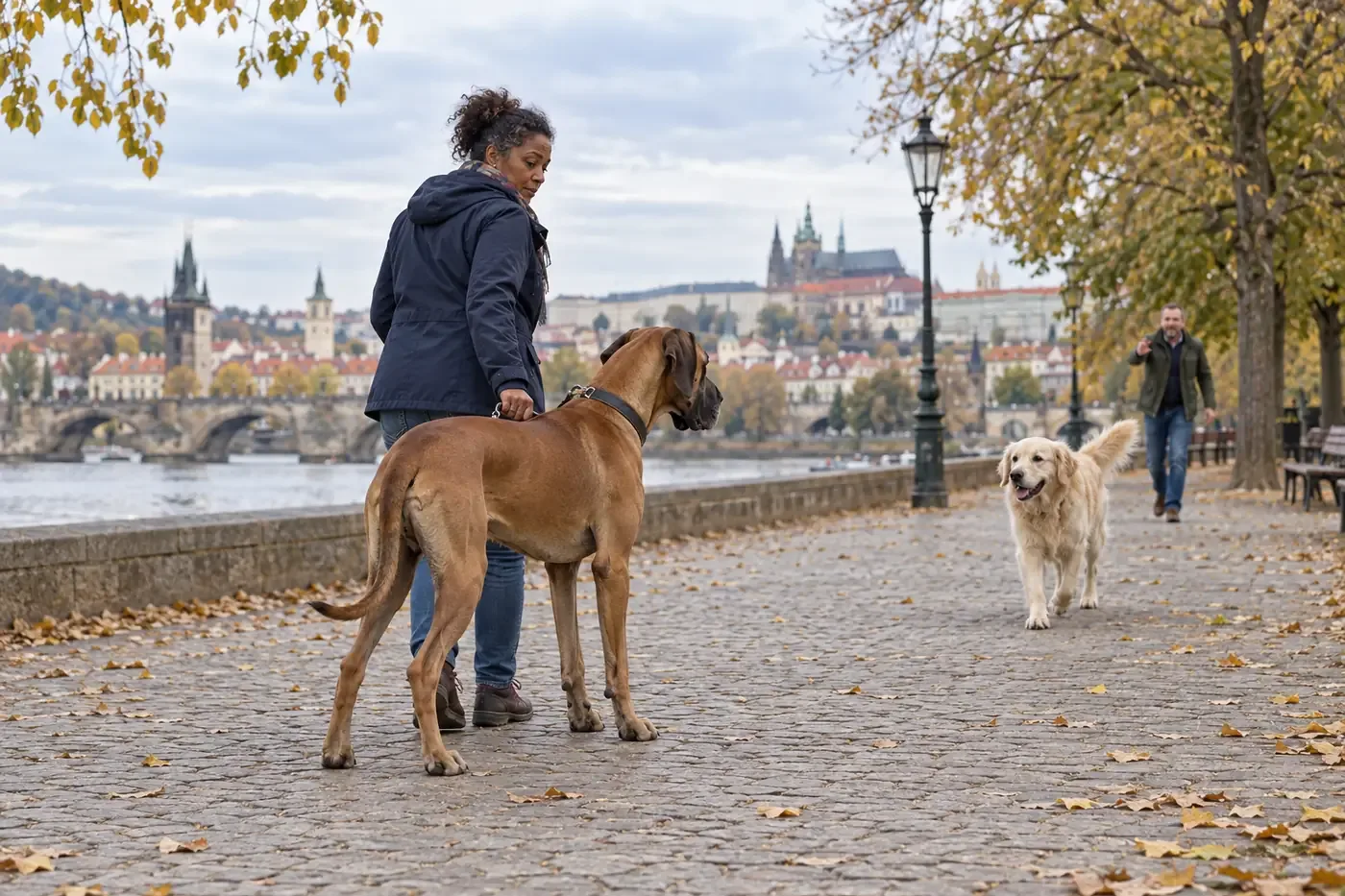
For owners of strong, large dogs, route choice matters too. Pick paths with room to step aside, avoid bottlenecks at peak times, and use equipment you can manage without pain. This is preparation, not a claim that a large dog is inherently unsafe. A dog’s size changes the margin for handling error.
What if the other dog makes contact?
Keep your hands away from mouths and collars. If the dogs can separate by moving, guide your dog away. If there is a bite or injury, get veterinary care, exchange details when it is safe, and write down the location and time. Do not continue a stressful walk just because the dogs have stopped moving.
Afterward, give your dog quiet recovery time. One bad encounter does not mean your dog can never meet another dog. It does mean the next interaction should be chosen, structured, and easy to leave.
What to do after a bite, injury, or frightening incident
If anyone is bitten, or either dog is injured, seek appropriate medical or veterinary care first. Do not decide the severity from a quick look while adrenaline is high. When it is safe, exchange contact details and note the time, exact location, descriptions of the dogs, and what happened immediately before contact. Photograph visible injuries only if doing so does not delay care.
For your own dog, watch for stiffness, punctures hidden by fur, reluctance to move, appetite changes, or behavior changes over the next day. Call your veterinarian if you have any concern. Keep a factual record rather than trying to establish blame on the pavement. That record can help your veterinarian or behavior professional understand what needs to change.
Do not immediately test whether your dog is “over it” with another greeting. Choose quiet decompression, then return to walks with enough space. If your dog starts reacting at distances that were previously easy, get support before repeating close encounters.
When should you get professional support?
Talk to your veterinarian if this is a sudden change or pain may be involved. A qualified behavior professional can help if reactions intensify, you are avoiding walks, or there is a bite history. The AVSAB supports reward-based behavior work, which is the foundation for teaching safer alternatives without adding fear.
Ask a professional what they will observe and how they will keep everyone safe. A good assessment considers the dog’s health, trigger distance, route, equipment, recovery time, and previous incidents. It does not require you to recreate the worst event. Bring a written timeline and, only when safely obtained, short videos from a distance.
The VCA assessment guidance explains why details such as the other dog’s behavior, your dog’s early signals, and recovery time matter. It also warns against removing a safety barrier merely to test a dog’s response.
What is the goal of the next walk?
The goal is not a greeting. It is a walk your dog can finish feeling safe. Create space, use a practiced turn, and leave early. For more tailored reading, browse the dog care guides or return to Fennaro to plan a compatible meeting instead of relying on chance.
Common questions
What should I do if an off-leash dog runs toward my leashed dog?
Create distance before the dogs meet. Cross the street, turn around, or use a parked car or other object as a barrier. Ask the other handler to call their dog. Keep moving rather than waiting for a greeting. Your dog may be leashed for training, fear, recovery, or simply because they do not want contact.
Why does my dog react more when they are on leash?
A leash can limit how a dog moves away, curves around, pauses, or ends an interaction. A reaction may reflect fear, frustration, surprise, pain, or learned history. It does not identify your dog as bad. Distance and predictable handling are more helpful than requiring a greeting with an unfamiliar dog.
Should I let the dogs say hello?
You do not have to. A rushed greeting between an off-leash dog and a dog on leash is an uneven situation. If both handlers later want an introduction, arrange it in open space with a parallel walk and an easy exit. Keep the first contact brief and stop while both dogs are comfortable.
What should I say to the other dog owner?
Use a short request early: ‘Please call your dog. Mine needs space.’ You do not owe an explanation of your dog’s training or health. Keep moving while you speak. If the other person does not respond, focus on getting away rather than arguing about whose dog is friendly.
Should I tighten the leash when another dog comes near?
Keep enough length to guide your dog away without trapping them against your leg or allowing them to reach the other dog. Avoid continuous pulling. Turn and walk away, then reward your dog for following. Practice this move in easy settings so it is familiar when a loose dog appears.
When do I need professional help for leash reactivity?
Seek veterinary input for sudden behavior change, pain, or difficulty walking. Seek a qualified behavior professional if your dog lunges, panics, bites, cannot recover after seeing dogs, or makes walks unsafe. A good plan changes the setup and teaches skills gradually rather than forcing repeated close encounters.