- Behavior
- Meetups
- Safety
Dog Guards Food or Toys From Other Dogs: What to Do
On this page
TL;DR: If your dog guards food or toys from other dogs, remove those resources from meetups, give both dogs room, and do not make them prove they can share. A growl is useful warning information. The safest first social plan is a walk or calm sniffing time with no bowls, chews, balls, or scattered treats.
Many dog conflicts begin with an item that looked harmless five minutes earlier. A tennis ball, a bully stick, a dropped treat, or a favorite patch of grass can change the conversation between dogs. The useful question is not whether your dog is “good” with dogs. It is whether this dog can stay relaxed around this resource in this setting.
What does resource guarding between dogs look like?
Resource guarding is behavior intended to keep access to something valuable. Food, treats, toys, chews, beds, resting spaces, and people can all be resources. Dogs Trust explains that a dog may stiffen, growl, snap, or bite when another dog or person approaches something they value.
The behavior exists on a scale. PetMD's veterinary-reviewed guide lists eating faster, hovering, stiffening, staring, carrying an item away, growling, snapping, and biting. A dog does not need to bite before you take the situation seriously.
Which early signs should you notice?
Look at the whole dog and the context. A dog may lower its head over the item, turn its shoulder toward an approaching dog, become still, give a hard look, eat faster, or carry the item away. These signs are a reason to reduce pressure, not to approach closer for a better look.
Keep an eye on the dog that is approaching too. A friendly dog may keep coming because it wants the ball, while the other dog is asking for space. Neither dog needs to be blamed. Your job is to interrupt the setup before either one feels forced to escalate.
Why should meetups start without food and toys?
Resource management is the simplest safety tool. PetMD recommends separating dogs for meals when food guarding occurs, and removing the trigger item or providing it only when dogs are separated when toys or chews cause trouble.
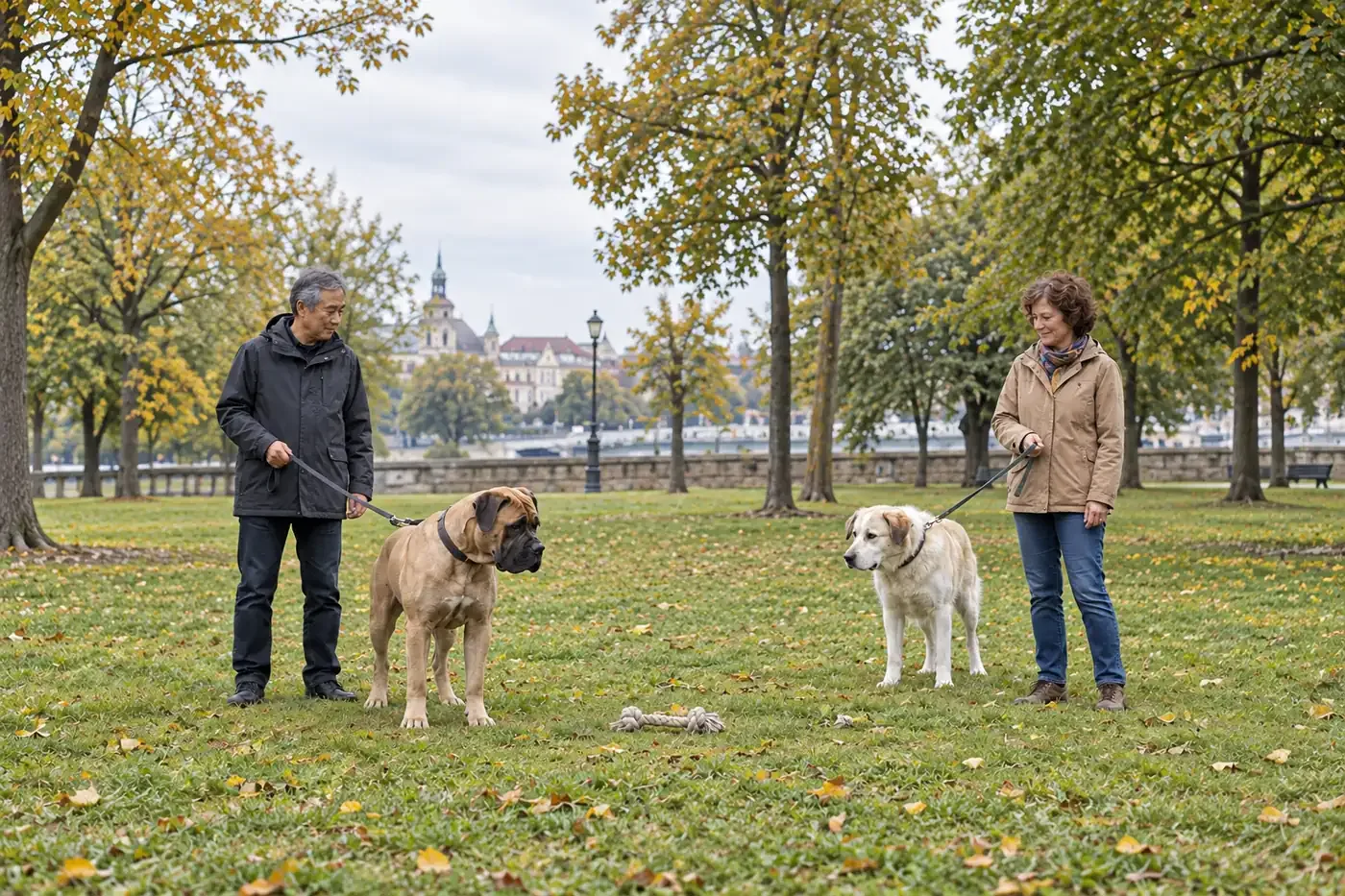
For a first meeting, pack water and walking gear, but leave balls, chews, and picnic food in the car. Do not scatter treats on the ground. Give each dog a chance to sniff, move, and disengage. Read how to introduce two dogs safely for a calm first-meeting setup.
Set up the first meeting before either dog arrives
Meet on neutral, open ground rather than at a front door, a fenced run, or beside a car boot full of gear. Start with two handlers and two dogs walking in the same direction, far enough apart that neither dog is staring, pulling, or unable to sniff. There is no useful universal distance. The right distance is the one where both dogs can notice each other and remain loose.
Keep leads long enough for normal walking but short enough to turn away. Do not bring a toy “just in case,” even if it stays in a pocket. A dog can smell food and recognize the shape of a familiar ball before it appears. Plan a brief walk, then leave while the dogs are still coping well. If they meet again, repeat the same low-pressure format before adding more freedom.
The aim is not instant play. It is a calm record of being near another dog without having to guard anything. That makes the next session easier to assess.
What should you do when a dog stiffens or growls?
Stop the other dog from approaching. Call them away, step in a different direction, or use a gate or car as a visual barrier. Do not put hands near mouths, grab a collar beside a valued item, or try to take the object while both dogs are close.
Once there is space, remove the resource only if doing so is safe. Often the sensible choice is to leave the object and move the dogs away. A lost toy is cheaper than an injury. End the activity or switch to a parallel walk rather than returning immediately to the same setup.
Use a simple response sequence
- Stop the approach. Call or guide the dog moving toward the item away. Do not ask the guarding dog to tolerate another dog getting closer.
- Open space. Move in opposite directions or place a visual barrier between the dogs. Avoid pulling them face to face on tight leads.
- Secure people first. Keep children, visitors, and extra handlers away from the item and the dogs. Nobody should reach in to “help.”
- Make a safe choice about the item. Pick it up only after the dogs are truly separated and calm. If that cannot be done safely, leave it and change location.
- End or simplify. A short, calm walk after separation may be appropriate. Reintroducing the same toy or treat is not.
This sequence is deliberately unexciting. It gives everyone a job and reduces the chance that several people talk, grab, or move at once. If a dog has already bitten, use management and professional help rather than attempting a public reset.
Should you punish the growl?
No. A growl tells you a dog is uncomfortable. Punishing it can remove the warning without changing the underlying concern. The American Veterinary Society of Animal Behavior recommends reward-based methods for behavior modification and advises against aversive methods.
Training trades and “drop it” can be useful away from the meetup. The Merck Veterinary Manual describes rewarding a dog for voluntarily giving up a toy or chew, beginning with low-value items. Do not use another dog as the test of whether the training worked.
Training also needs a clear stopping rule. If the dog freezes, stops taking food, hardens its stare, or begins to guard the trainer’s hand, the exercise is too difficult. Go back to an easier item or larger distance. A “trade” is only useful when the dog can choose it without pressure. Repeatedly taking possessions to show control can make the person part of the threat picture.
How can you plan a lower-risk dog outing?
Choose an open area with a clear exit. Keep the first outing short. Start with one compatible dog, not a crowd. Ask every handler to keep food and toys out of the shared space. If treats are needed for a cue, use them quietly and at a distance from the other dog.
Fennaro lets owners state practical boundaries before meeting, including lead use and group size. Plan the meetup in Fennaro and use the dog care guides to choose a suitable next read. A good outcome may be two dogs walking near each other calmly. It does not have to be rough play.
Food and water need their own plan
Dogs still need water on a warm outing, but one shared bowl can become a pinch point. Bring a separate portable bowl for each dog, put the bowls down well apart, and let dogs drink in turns if either one shows interest in the other’s water. Pick bowls up before moving on. Do not hand out treats in a cluster of dogs, even for recalls. Move away from the group first, reward your own dog, then rejoin only if the situation remains easy.
For a public meetup, say this in the invitation rather than trying to explain it after a growl: no food on the ground, no chews, no balls, separate water breaks, and no child is responsible for a dog. These are ordinary event rules, not a judgment about anyone’s dog.
Public outings and multi-dog homes are different
At home, dogs may guard predictable things such as bowls, beds, doorways, or a person’s lap. They need routine management every day: feed separately, give chews behind a barrier, and avoid making one dog wait beside another dog’s meal. The Veterinary Partner guidance advises feeding pets in separate rooms where they cannot see each other when guarding is present.
At a public meetup, the safest answer is often simpler: no valuable resources at all. A dog that manages well at home may be more sensitive around unfamiliar dogs. A dog that only guards from one housemate may still cope on a walk. Do not assume either pattern transfers. Make decisions from the dog you are seeing that day.
When should you call a professional?
Call your veterinarian when guarding appears suddenly, pain or illness is possible, or a dog has injured someone. Contact a qualified behavior professional when there is snapping, biting, repeated chasing, or a situation you cannot manage safely. The ASPCA advises seeking qualified help when warning signs emerge during food-guarding work.
A useful professional assessment asks more than “does your dog guard?” It looks at what is guarded, who approaches, how close they are, the dog’s early signals, health history, and what has already happened after a growl. Bring short notes, not risky reenactments. Record the item, location, dog present, body language, and outcome after each incident. Video can help only when it is made from a safe distance and does not delay separating the dogs.
Do not try another dog meetup while there is an unresolved bite history, a recent unexplained change in behavior, or a handler who cannot physically manage the dog. Work with the veterinarian or qualified professional first. Some dogs will do best with walks and distance from other dogs rather than shared toys or off-lead play. That is a valid social plan.
What matters most at the next meetup?
Dogs do not need to share everything to have a successful social life. Remove high-value items, read the first signs of tension, create space quickly, and choose activities that do not ask dogs to compete. That is a more useful plan than hoping they will work it out.
For another structured meeting guide, return to Fennaro and match the plan to the individual dog in front of you.
Common questions
What should I do when my dog growls at another dog over food?
Create distance first. Call the other dog away, remove access to the food once both dogs are safely apart, and end that shared-resource situation. Do not punish the growl or reach between dogs. If there was a snap, bite, or repeated incident, contact your veterinarian or a qualified behavior professional before another shared outing.
Why does my dog guard toys from other dogs but not from me?
Guarding can be specific to the resource and the perceived competitor. A dog may be comfortable handing you a toy, then feel pressured when another dog approaches it. That does not mean the dog is trying to be dominant. It means this combination of item, dog, distance, and setting needs management.
Can dogs with resource guarding play with other dogs?
Some can enjoy walks and social time when food, chews, toys, and other disputed items are absent. Play is not the only successful social activity. Parallel walking, sniffing, and short calm visits may suit a dog better. A bite history or escalating behavior needs an individual professional assessment before group play.
Should I take a bone away if my dog growls?
Do not take it by force. Move people and other dogs away, then allow the dog space to settle. Training a trade or drop cue belongs in a low-pressure setting, beginning with easy items. Trying to practice around a valuable chew during a meetup can add risk instead of teaching a useful response.
Are balls safe at a dog meetup?
Not as a default. Balls can become a high-value resource even for dogs that usually play well together. Leave toys, chews, and food out of early meetings. If familiar dogs later share a space with toys, supervisors should stay close, watch body language, and stop play at the first sign of tension.
When is resource guarding an emergency?
Treat guarding seriously when a dog freezes, blocks access, repeatedly growls, chases, snaps, bites, or leaves an item to confront another dog or person. Keep children away from the situation. Get veterinary advice promptly when injury, sudden behavior change, pain, or a pattern of escalating aggression is involved.